Budget Travel in Korea 2026: How to Explore Seoul for Under $50/Day
Updated for March 2026
Korea has a reputation that can intimidate budget travelers — flashy department stores, luxury skincare boutiques, and Michelin-starred tasting menus are everywhere. But look past the shiny surface and you will find one of the most rewarding countries in the world for travelers on a tight budget. A full day of exploring Seoul — with meals, transport, and activities — can be done for well under $50 USD if you know where to go and what to avoid.
This guide is built around a realistic daily budget framework for travelers who want to experience Korea fully without spending like a high-roller. Every figure here is grounded in 2026 prices.
💰 The $50/Day Budget Framework
Before breaking down each category, here is a realistic daily budget allocation:
The key insight: Korea's affordable food and transport systems do almost all the heavy lifting. If you eat where Koreans eat and move around by subway, your daily costs drop dramatically.
🍱 Food: Eat Well for Under $15/Day
Gimbap Restaurants (분식집) — Your Best Friend
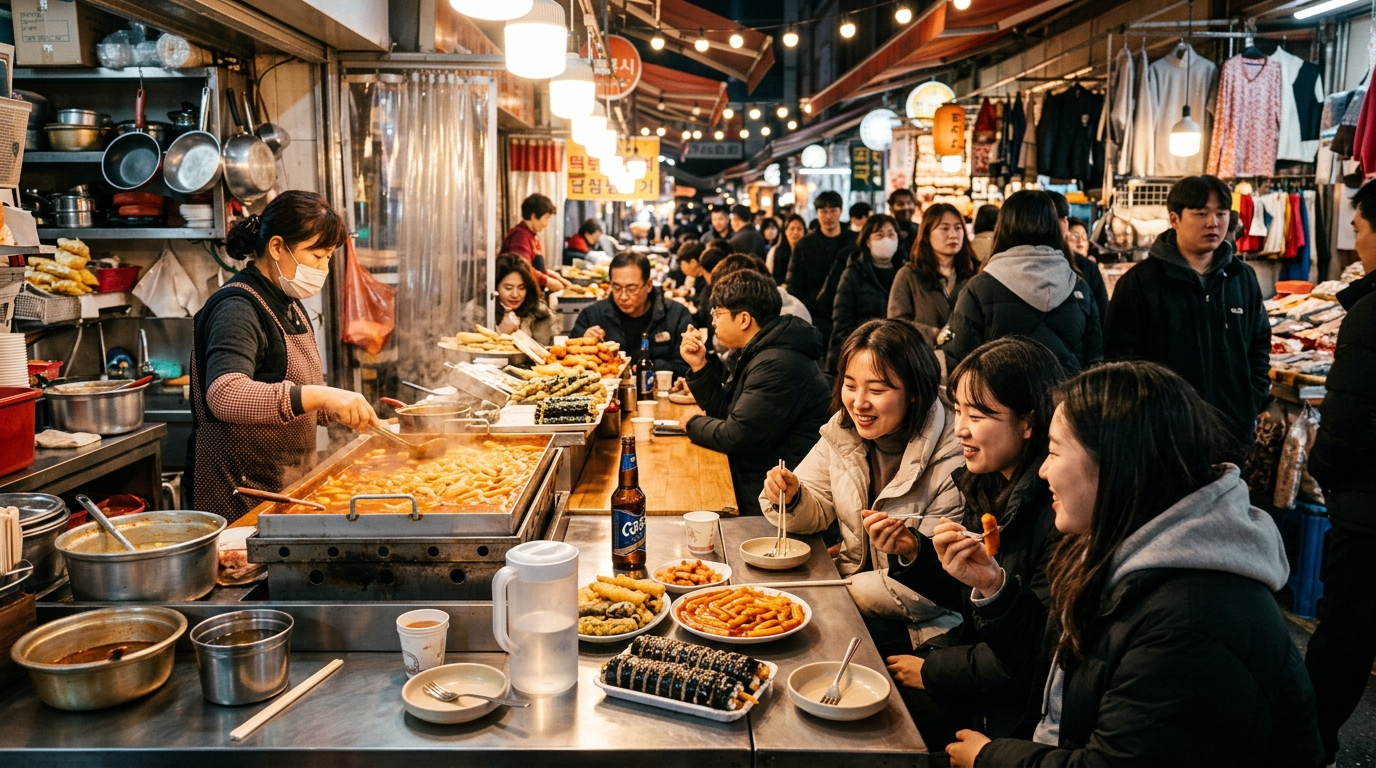
The cornerstone of budget eating in Korea is the humble gimbap restaurant (분식집, bunsikjip). These are casual, fast-service eateries serving Korean comfort food at prices that have barely changed in years. A full meal rarely exceeds ₩5,000–8,000 (approximately $3.50–5.50).
What to order: - Gimbap (김밥): Seaweed rice rolls with fillings — a full roll costs ₩3,000–4,500 and is more filling than it looks - Tteokbokki (떡볶이): Spicy rice cakes, ₩3,000–5,000 for a generous portion - Ramyeon (라면): Instant-style noodle soup, ₩3,000–4,500 - Dosirak (도시락): Pre-packed lunch boxes, ₩5,000–7,000
The chain Kimbap Cheonguk (김밥천국) is found throughout Seoul and is a reliable, no-surprises option. Independent bunsikjip tend to be even better quality.
Convenience Stores — Korean Style
Korean convenience stores — GS25 (지에스25), CU (씨유), and 7-Eleven (세븐일레븐) — operate on a different level from their Western equivalents. A fully prepared hot meal from a Korean convenience store is genuinely good food:
- Samgak gimbap (삼각김밥): Triangle rice snacks, ₩1,500–2,000 each
- Cup ramyeon (컵라면): Eaten with hot water from the store's dispenser, ₩1,500–2,500
- Lunchbox sets (도시락): ₩3,500–5,500, surprisingly complete meals
- Steamed buns (찐빵/호빵): ₩1,000–2,000 each
Many convenience stores have seating areas. A full convenience store meal for ₩5,000–7,000 is legitimate budget travel in Korea, not a compromise.
Markets and Street Food
Traditional markets offer some of the cheapest full meals in the country. Gwangjang Market (광장시장) in Jongno is famous for its bindaetteok (녹두빈대떡, mung bean pancakes at ₩4,000–5,000) and raw bibimbap (₩8,000–10,000). Tongin Market (통인시장) near Gyeongbokgung operates a coin dosirak café where you buy brass coins for ₩5,000 and exchange them for small portions from different vendors — a perfect budget lunch experience.
Street food staples to look for: - Hotteok (호떡, sweet stuffed pancakes): ₩1,500–2,000 - Gyeran-ppang (계란빵, egg bread): ₩2,000 - Sundae (순대, blood sausage): ₩3,000–5,000 per portion - Bungeo-ppang (붕어빵, fish-shaped pastry): 3 for ₩2,000
Expert Tip: Avoid eating anywhere with an English menu prominently displayed outside in major tourist areas like Myeongdong (명동) or Insadong (인사동). These restaurants price for tourists. Walk one or two blocks off the main street and prices drop by 30–50%.
🏛️ Free Attractions: Seoul Has Dozens
One of Seoul's best-kept secrets for budget travelers is how many of its best experiences cost absolutely nothing. Korea's national museums and many palaces offer free entry on specific days or are permanently free to enter.
Free Museums and Galleries
The National Museum of Korea is one of the finest museums in Asia and genuinely rivals the British Museum or the Smithsonian in scope. Spending an entire morning there costs nothing.
Free Palace Days
Korea's five grand palaces charge a modest admission fee (₩3,000), but all palaces offer free entry when wearing hanbok (한복) traditional dress. Many hanbok rental shops near the palaces offer rentals starting from ₩15,000–20,000 for two to three hours — meaning you get both a cultural experience and free palace entry for less than most admission fees elsewhere in Asia.
The palaces also offer free guided tours in English on selected days. Check the official websites for current schedules.
Free Parks and Nature
Seoul's park system is extensive and entirely free: - Bukhansan National Park (북한산국립공원): World-class urban hiking, free entry, accessible by subway - Seoul Forest (서울숲): Deer park, gardens, cycling — free - Olympic Park (올림픽공원): Eight outdoor sculptures, sports facilities — free - Cheonggyecheon Stream (청계천): 8km urban stream walk — free - Namsan둘레길 (둘레길): Hiking trails circling Namsan, entirely free (only the cable car costs money)
🏠 Accommodation: Goshiwon vs. Hostel
Goshiwon (고시원)
A goshiwon is a Korean micro-room originally designed for students preparing for civil service examinations (고시, gosi). They are extremely compact — typically a room just large enough for a single bed, a small desk, and narrow shelving — but they come with a private room, usually shared kitchen access, and sometimes free ramen and rice stocked in the communal area.
Cost: ₩250,000–400,000 per month, which works out to $5–9 per night if you are staying for a week or more and negotiate accordingly. Short-stay goshiwon (단기 고시원) accept guests by the night at slightly higher rates, typically ₩20,000–30,000 per night ($14–21).
Goshiwon are found in virtually every residential neighborhood in Seoul. They are less common on short-stay booking platforms but can be found through local Korean booking sites or by walking into a neighborhood and looking for the signs (고시원).
Best for: Solo travelers comfortable with minimal space, long stays, travelers who want a private room at hostel prices.
Hostels
Seoul has an excellent hostel scene centered around neighborhoods like Hongdae (홍대), Insadong (인사동), and Itaewon (이태원). Dorm beds in well-reviewed hostels run ₩15,000–30,000 per night ($10–21), with private rooms from ₩40,000–60,000.
Recommended hostel areas: - Hongdae: Young, energetic, excellent transport links, many budget options - Insadong/Jongno: Central, close to palaces and markets, quieter vibe - Seoul Station area: Maximum transit convenience, several budget options
🚇 Transport: T-Money and Discount Passes
T-Money Card (티머니 카드)
The T-Money card is the essential transit tool for any Seoul visitor. It is a rechargeable transportation card that works on the subway, buses, and many taxis, and it provides a small discount over cash fares on every single journey. Subway fares start at ₩1,400 per ride (approximately $1), making Seoul's metro one of the cheapest in any major world city.
Buy a T-Money card at any subway station ticket machine or convenience store for ₩3,000 (the card itself, loaded with your initial credit). Top up at any convenience store or station machine.
The card also works for transfers between subway and bus within 30 minutes — if your journey requires a subway-to-bus connection, the transfer fare is reduced significantly.
Korail Pass for Intercity Travel
If you plan to travel outside Seoul to cities like Busan (부산), Gyeongju (경주), or Jeonju (전주), the Korail Pass (코레일패스) offers foreign visitors unlimited KTX and Mugunghwa train travel for a fixed price. A 2-day consecutive pass costs approximately $65, which pays for itself quickly if you are making multiple intercity journeys.
Expert Tip: For day trips from Seoul, the T-Money card often covers suburban destinations via the regular subway network at standard fares. Suwon (수원), Incheon (인천), and even parts of Gyeonggi Province are accessible without any special pass.
Walking as a Strategy
Seoul is a far more walkable city than its size suggests. Many of the key tourist clusters are concentrated in areas where walking between attractions is practical and enjoyable: - Gyeongbokgung → Bukchon Hanok Village → Insadong: 30–40 minute pleasant walk - Myeongdong → Namdaemun Market → Seoul Station: 20–30 minute walk - Hongdae → Sinchon → Ewha: 20–25 minute walk
📋 Sample $40 Day Itinerary
Add hostel accommodation at ₩20,000 and your full day lands at approximately ₩45,000 ($32) — well under the $50 target, with room for a coffee or snack.
💡 Top Money-Saving Tips
Use the AREX, not the taxi. The AREX general train (일반열차) from Incheon Airport (인천국제공항) to Seoul Station costs approximately ₩4,150 and takes around 58 minutes, versus ₩70,000+ for a taxi. The non-stop Express (직통) costs ₩9,500 but is only worth it if time is critical.
Buy duty-free on the way out. If you plan skincare or cosmetics purchases, Korean duty-free shops at Incheon Airport departure side offer significant savings with foreign passport holders eligible for additional discounts.
Cook occasionally. Many hostels and all goshiwon have kitchens. A supermarket run at E-Mart (이마트) or Lotte Mart (롯데마트) — where a full grocery basket costs a fraction of restaurant prices — covers several meals.
Download Naver Maps (네이버 지도). It gives you real-time transit routing with accurate fare estimates, helping you plan journeys that minimize transfer costs.
Visit convenience stores after 9PM. Many stores discount prepared food approaching its sell-by time. Sandwiches, rice balls, and lunchboxes are often 30–40% off.
Skip the branded cafes. Coffee at a Starbucks in Korea costs ₩5,500–7,500 for a standard latte. A local coffee shop or a convenience store canned coffee costs ₩1,000–2,000 and is often better.
❓ Frequently Asked Questions
Q1: Is it really possible to eat three full meals in Seoul for under $15? Yes — consistently. The key is avoiding tourist-priced restaurants and eating at the places Koreans eat. Bunsikjip meals average ₩5,000–7,000. Two meals at a bunsikjip plus convenience store breakfast or street snacks puts you well under ₩18,000 ($13) for the day with no sacrifice in quality or quantity.
Q2: Are goshiwon safe for foreign travelers? Generally yes — goshiwon are legal, regulated accommodations found throughout Korea's cities. The main consideration is the small room size and limited English communication with building managers. Most short-stay goshiwon targeting travelers are accustomed to foreign guests. Booking through a platform like Airbnb (which lists some goshiwon-style spaces) or through Korean accommodation apps with English interfaces is the safest approach.
Q3: Is free entry at Korean national museums really free — no hidden costs? For the permanent collections, yes — completely free. Temporary exhibitions inside the same buildings sometimes charge ₩3,000–12,000 separately. The National Museum of Korea's permanent galleries alone are worth several hours and cost nothing.
Q4: What is the cheapest way to get a SIM card in Korea? Purchasing a prepaid tourist SIM at Incheon Airport from providers like KT, SKT, or LG U+ costs approximately ₩20,000–35,000 for 5–10 days of unlimited data. This is significantly cheaper than international roaming from your home carrier and essential for using maps and translation apps throughout your trip.
Q5: How do I find the cheapest accommodation booking options in Korea? For hostels, Hostelworld and Booking.com both list Seoul properties extensively. For goshiwon and budget guesthouses, the Korean platform Yeogi Eo Ttae (여기어때) and Naver Hotel (네이버호텔) sometimes have lower rates than international platforms. Always compare before booking.