Gyeongbokgung Palace Guide 2026: Seoul's Greatest Royal Palace
Updated for March 2026
At the northern end of Sejongno, framed by the granite ridgelines of Bugaksan and flanked by the modern towers of central Seoul, Gyeongbokgung Palace (경복궁) stands as the most complete and most powerful statement of Korean royal history that survives in the city. Built in 1395 as the principal palace of the newly established Joseon Dynasty, it served as the seat of Korean kingship for over five centuries — and though it was burned by Japanese forces in 1592 and substantially dismantled during the Japanese colonial period, its ongoing reconstruction since the 1990s has returned it closer to its original grandeur than at any point in the past 400 years.
Today, Gyeongbokgung is the most-visited cultural attraction in Korea. On any given day, thousands of visitors move through its gates — many in rented hanbok (한복), their traditional robes creating a living anachronism against the palace's painted timber columns and stone courtyards.
🏯 Essential Information
🎭 The Changing of the Guard Ceremony (수문장 교대식)
The single most photographed event at Gyeongbokgung is the Royal Guard-Changing Ceremony (수문장 교대식) — a historically reconstructed pageant in which ceremonial guards in full Joseon-era armor and dress perform the changing of the palace gate watch.
Schedule: - 10AM and 2PM daily (except Tuesdays when the palace is closed) - Duration: approximately 20 minutes - Location: Gwanghwamun Gate (광화문) plaza and the Heungnyemun inner gate
The ceremony involves a procession of 30–40 guards in red and blue robes, elaborate headdresses, and carrying traditional weapons, accompanied by court music. The visual spectacle is impressive and entirely free — no palace admission required to watch from the Gwanghwamun plaza.
Tip: Arrive 15 minutes early. The best viewing positions at the gate fill quickly.
🗺️ What to See Inside: A Visitor Route
1. Gwanghwamun Gate (광화문)
The three-arched southern gate of Gyeongbokgung is the largest and most imposing of any Korean palace gate. The current structure was rebuilt in 2010 following its demolition during the Japanese colonial period. The central arch was traditionally reserved for the king alone; today all visitors pass through it. The painted eave decorations — intricate dancheong (단청) patterns in red, blue, green, and gold — were restored using documented historical color schemes.
2. Heungnyemun Gate (흥례문) and the Inner Plaza
Passing through Gwanghwamun leads to a second gate and a large ceremonial courtyard. The small stream channel (어구,御溝) crossing the courtyard — a ritual purification threshold — is one of the architectural details that distinguishes the palace's ceremonial design.
3. Geunjeongjeon Throne Hall (근정전) ★
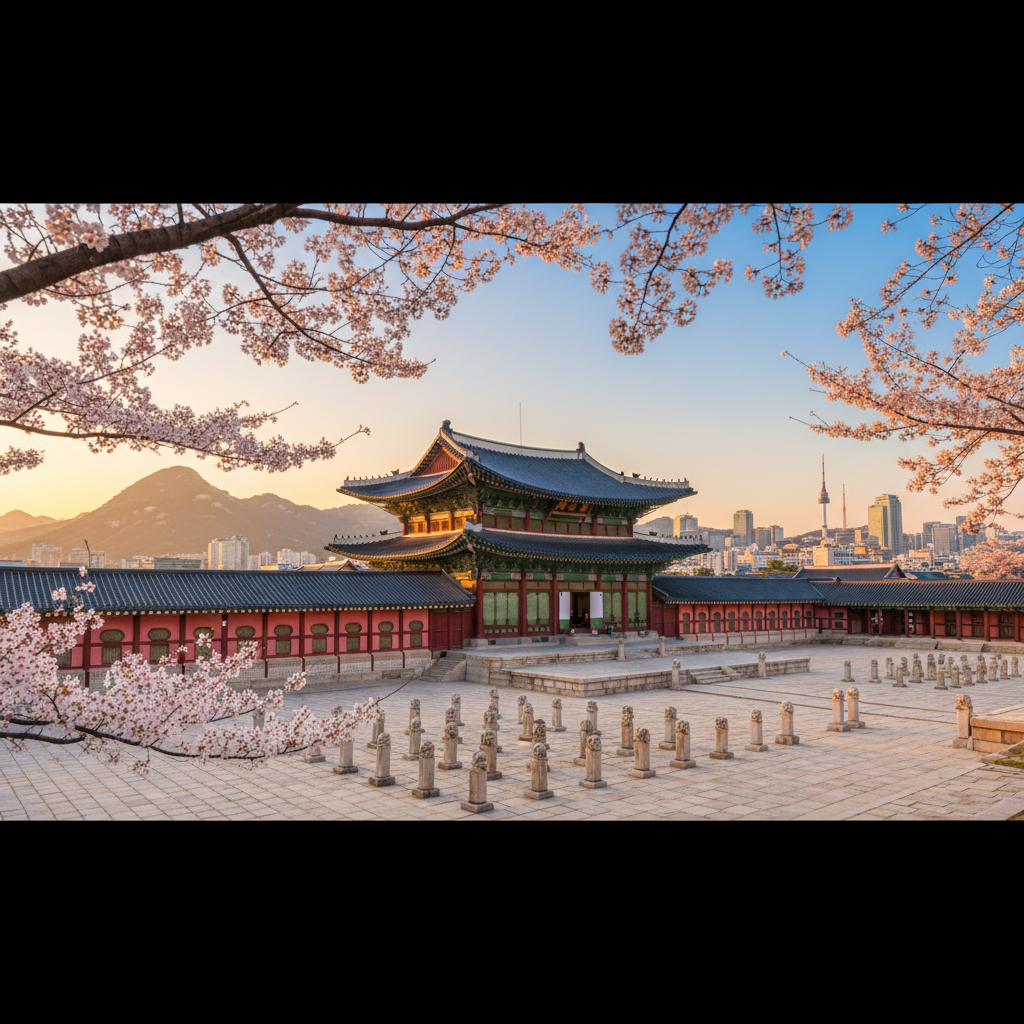
The undisputed architectural centerpiece of Gyeongbokgung — and arguably of all Korean royal architecture. The two-story throne hall stands on a two-tiered stone platform (월대, woldae) surrounded by stone rank markers indicating where officials stood during royal audiences. Inside, the gilded wooden throne beneath a painted ceiling canopy represents the height of Joseon craftsmanship.
What to look for: - The stone rank tiles (품계석, pumgyeseok) arranged in rows across the courtyard — officials of different ranks stood at their corresponding stone - The carved stone phoenixes on the roof finials — the symbol of the queen - The ceiling inside: a golden dragon (용) coiled above the throne — the symbol of the king
4. Sujeongjeon Hall (수정전)
A smaller hall west of the throne hall where King Sejong's Hall of Worthies (집현전) was located — the institution responsible for creating Hangul (한글), the Korean alphabet, in 1443. The modest scale of this historically transformative building is quietly remarkable.
5. Gyeonghoeru Pavilion (경회루) ★
The two-story wooden pavilion standing on stone pillars in the middle of an artificial lotus pond is one of the most iconic images in Korean history — built for royal banquets and diplomatic receptions, with the northern mountain visible as its backdrop. The pavilion is accessible only by guided tour (advance booking via the palace website), but the view from the pond's perimeter is itself one of the finest in Seoul.
Photography note: The Gyeonghoeru reflection in the pond on calm mornings is considered one of Seoul's most photographed images. Arrive at opening time (9AM) for still water and soft light.
6. Hyangwonjeong Pavilion (향원정)
A hexagonal pavilion on a small island in the northern garden's pond, connected to the shore by the Chwihyanggyo Bridge (취향교). More intimate than Gyeonghoeru, the northern garden around Hyangwonjeong represents the private residential character of the palace versus the ceremonial formality of the southern sections.
7. Donggung (동궁) — Crown Prince's Quarters
The eastern compound housed the Crown Prince and his household. The reconstructed buildings give a sense of the palace's scale as a self-contained royal city rather than a single building.
8. National Folk Museum (국립민속박물관)
Located within the palace grounds (separate entrance but included in palace admission), the National Folk Museum provides a thorough introduction to Korean traditional life — housing, clothing, food culture, and seasonal customs across the Joseon period. One to two hours gives a solid overview. English descriptions throughout.
👘 Hanbok Rental: The Full Guide
Wearing hanbok (한복) provides free admission to Gyeongbokgung — and to Changdeokgung, Changgyeonggung, Deoksugung, and Gyeonghuigung palaces as well.
Rental shops: Dozens of hanbok rental shops cluster along Gyeongbokgung-ro (경복궁로) and the side streets between Gyeongbokgung and Gyeongbokgung Station. Rental typically includes the full outfit (jeogori jacket + chima skirt for women; jeogori jacket + baji trousers for men), hair accessories, and bag.
Typical pricing: - Standard hanbok: ₩15,000–20,000 for 2–3 hours - Premium hanbok (higher-quality fabrics, more elaborate styles): ₩25,000–40,000 - Couple/group discounts are common
Tips: - Book in advance on weekends — shops fill up, particularly in spring and autumn - Hair styling (머리 올림) is offered for an additional ₩5,000–10,000 at most shops - Return the hanbok before the rental period ends — late fees apply
🌸 Best Times to Visit
Current season (March): Early cherry blossom possible in the palace grounds by late March. The light is soft and conditions are excellent.
🗺️ Combining with Nearby Attractions
Gyeongbokgung sits at the center of a cluster of major attractions walkable from the palace:
- Bukchon Hanok Village (북촌 한옥마을): 15-minute walk northeast — traditional tile-roofed residential neighborhood
- Insadong (인사동): 15-minute walk southeast — arts, crafts, tea houses
- Gyeonghuigung Palace (경희궁): 15-minute walk west — smaller, less visited palace
- Cheong Wa Dae (청와대, Blue House): 10-minute walk north — the former presidential residence, opened to public tours since 2022
- Inwangsan Mountain (인왕산): 20-minute walk west — shamanist shrines and city views
❓ Frequently Asked Questions
Q1: How much time do I need at Gyeongbokgung? A thorough visit covering the main buildings, the National Folk Museum, and the northern garden takes 3–4 hours. If also renting hanbok and photographing, allow 4–5 hours. A quick visit covering only the throne hall and Gyeonghoeru pavilion can be done in 90 minutes.
Q2: Is the entire palace reconstructed or original? A mix. Geunjeongjeon, Gyeonghoeru, and Hyangwonjeong survived destruction and are substantially original. The outer gates, Donggung, and many secondary structures are 20th and 21st-century reconstructions based on historical records and archaeology. Reconstruction is ongoing — sections under scaffolding are common.
Q3: Can I visit Gyeongbokgung at night? Special evening opening events (야간개장) are held in spring and autumn with extended hours and atmospheric lighting. These are announced seasonally via the palace website and sell out quickly. Normal daytime admission closes at 5–6PM.
Q4: Is the Gyeonghoeru pavilion interior accessible? Only through a paid guided tour (approximately ₩2,000 additional), which must be booked in advance on the palace website. Tour numbers are very limited. The pavilion exterior and pond are freely accessible during normal visiting hours.
Q5: Are the five Seoul palaces worth visiting together? Each of the five Joseon palaces (Gyeongbokgung, Changdeokgung, Changgyeonggung, Deoksugung, Gyeonghuigung) has a distinct character. The Palace Combined Ticket (고궁통합관람권) at ₩10,000 covers all five for one month — excellent value for those interested in Korean history.