Insadong Guide 2026: Traditional Arts, Tea Houses & Ssamziegil in Seoul
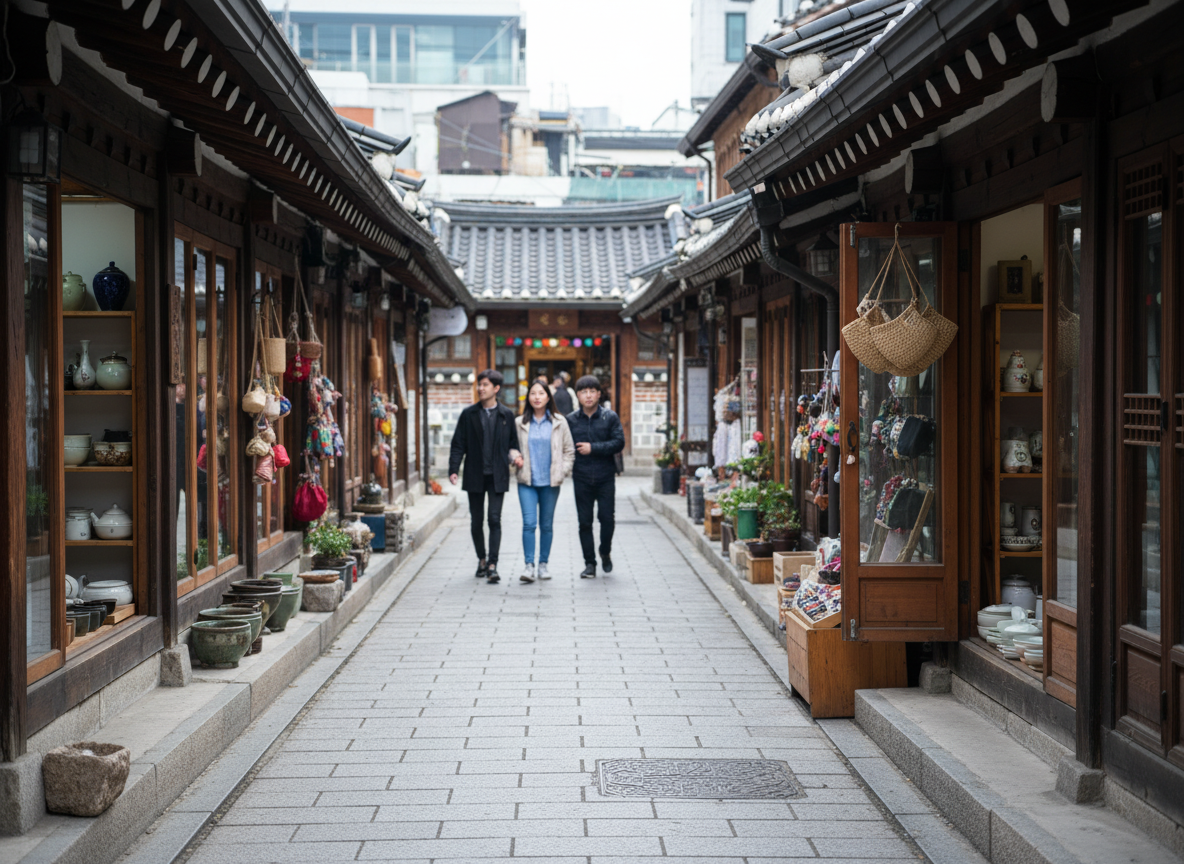
Updated for March 2026
A fifteen-minute walk north from Gwanghwamun, the alley network of Insadong (인사동) occupies a distinctive place in Seoul's landscape: a neighborhood that resisted the homogenizing pressure of the city's rapid modernization and retained — through the concentration of galleries, antique dealers, calligraphy shops, and traditional tea houses — a cultural identity rooted in Korea's artistic traditions.
The main street (인사동길) runs roughly north to south for about 700 meters, flanked by dozens of narrower alleyways (골목) that reward slower exploration. The combination of accessible cultural content, distinctive food, independent shops, and a pace noticeably slower than the surrounding city makes Insadong one of Seoul's most satisfying neighborhoods to spend a half-day.
📋 Essential Information
🗺️ The Neighborhood Layout
Insadong's main artery runs from Anguk Station in the north to the Tapgol Park (탑골공원) area near Jongno in the south. The street is dense enough that all main attractions are within walking distance of each other, but the neighborhood rewards leaving the main street for the smaller alleys (골목) running east and west.
Key sub-areas: - Upper Insadong (북쪽): Near Anguk — denser gallery concentration, quieter - Ssamziegil (쌈지길): Mid-street — the cultural courtyard complex; landmark - Lower Insadong (남쪽): Toward Jongno — more street food stalls, touristy
🏛️ What to See & Do
Ssamziegil (쌈지길) ★
The neighborhood's most distinctive physical space — a four-story spiral courtyard complex built in 2004 around a central open-air atrium. The design by architect Choi Moon-gyu deliberately subverts the typical shopping mall format: the building winds upward on a continuous ramp, with small independent shops and studios opening onto the walkway at irregular levels.
What's inside: - Independent craft shops (handmade jewelry, ceramics, paper goods, textiles) - Small cafés and dessert vendors - A regular schedule of outdoor performances and art installations in the central courtyard - A rooftop terrace with views over the Insadong neighborhood
Ssamziegil is free to enter and operates roughly 10AM–8:30PM daily.
Traditional Tea Houses (전통찻집)
Insadong has the highest concentration of traditional Korean tea houses (전통찻집) in Seoul — businesses that serve not just tea but a particular atmosphere of wooden interiors, floor cushion seating, ceramic cups, and quiet. The best tea houses in Insadong are often on upper floors reached by steep wooden staircases, with views over the alley below.
What to order: - Ssanghwa-cha (쌍화차): Traditional herbal tonic — dark, slightly bitter, rich; served with pine nuts floating on the surface. The standard medicinal drink of traditional Korea. - Yuja-cha (유자차): Citron tea — fragrant, sweet-sour; made by stirring preserved citron paste into hot water. - Omija-cha (오미자차): Five-flavor berry tea — a striking red color; sweet, sour, salty, bitter, and pungent in one cup. - Daechu-cha (대추차): Jujube tea — gentle, sweet; reddish-brown; the most approachable for first-time visitors.
Traditional Craft & Art Shops
The main street and its alleys are lined with shops selling: - Hanji (한지): Traditional Korean mulberry paper — sold in sheets or as notebooks, fans, lanterns, and boxes. One of the most culturally specific and practical souvenirs. - Ceramics (도자기): From mass-produced celadon reproductions to handmade studio pieces by working potters. - Calligraphy (서예) supplies: Ink sticks, brushes, seal stamps (도장) — the seal stamp culture particularly: visitors can have their name carved in hangul or Chinese characters. - Korean masks (탈): Traditionally used in shamanistic and theatrical performances — now sold as wall decoration.
Galleries
Insadong contains approximately 100 galleries ranging from commercial print shops to serious contemporary art spaces. The concentration is highest in the northern section near Anguk. Gallery visits are generally free. Notable permanent spaces include:
- Gana Art Space: Contemporary Korean art
- Arario Gallery Insadong: International contemporary art in a renovated traditional building
- Several smaller studios where working artists sell directly
Tapgol Park (탑골공원)
The southern end of Insadong leads to Tapgol Park — Korea's first modern public park (established 1897) and a site of deep historical significance. The park contains the 10-story Wongaksa Pagoda (원각사지 10층석탑), a National Treasure from 1467, and a series of bas-relief paintings depicting the March 1st Independence Movement of 1919, which was declared here.
🍽️ Where to Eat in Insadong
Traditional Korean Food
- Sanchon (산촌): Temple food (사찰음식) restaurant in a renovated traditional house — vegetarian, complex, beautiful presentation; one of the most authentic Korean dining experiences in Insadong.
- Insa-dong Maru (인사동 마루): Traditional Korean set meals (한정식) at accessible prices in a hanok building.
Street Food (Main Street Stalls)
Insadong's main street has several vendors worth stopping at: - Hotteok (호떡): Thick filled pancakes — sweet varieties (brown sugar and seeds) or savory green onion versions. - Hanji-wrapped ice cream: A theatrical presentation of soft serve ice cream wrapped in edible rice paper — primarily photogenic. - Tteok (떡): Traditional rice cakes sold from street carts — hundreds of varieties; try injeolmi (인절미, coated in roasted soybean powder) or songpyeon (송편, pine-needle-steamed half-moon cakes).
Cafés
Independent cafés are embedded throughout the alleys — look for small hanok-style buildings or converted storefronts with handwritten menus. Coffee culture in Insadong trends more traditional: pour-over, traditional snacks alongside espresso, quieter atmosphere than the café districts of Hongdae or Seongsu.
🛍️ What to Buy
Best souvenirs from Insadong: 1. Hanji items (notebooks, fans, decorative boxes) — lightweight, culturally specific, available in all price ranges 2. Custom seal stamp (도장) — your name carved in stone while you wait; ₩5,000–15,000 3. Korean tea sampler — packaged traditional tea sets make excellent gifts 4. Ceramic tea bowl — a single handmade cup starts from ₩15,000 at studio shops 5. Korean mask (하회탈) — the Hahoe mask style from Andong is the most recognizable
Price note: Insadong operates on a mixed pricing model — fixed-price retail at most shops, with some negotiation possible at antique stalls. Tax refund (사후면세) applies at registered shops over ₩30,000.
🗺️ Combining with Nearby Areas
Bukchon Hanok Village (북촌 한옥마을): 10–15 minutes north by foot from Anguk Station — the most natural combination. Bukchon + Insadong forms the classic "traditional Seoul" full-day itinerary.
Changdeokgung Palace: 10 minutes east by foot — the Anguk area serves as the natural base for both Insadong and the palace district.
Samcheong-dong (삼청동): The alley running north from Anguk Station parallel to the palace wall — independent design studios, quieter cafés, art spaces; connects naturally to Bukchon.
❓ Frequently Asked Questions
Q1: Is Insadong worth visiting if I've already been to Bukchon? Yes — they are adjacent but distinct. Bukchon is primarily residential architecture and atmosphere. Insadong is active retail, galleries, and food. The two complement rather than duplicate each other.
Q2: What is the best time of day to visit? For the tea houses and galleries, afternoon (1–5PM) is ideal — more atmosphere, better light in the alleys. The Sunday pedestrian street closure (10AM–10PM) makes the main street significantly more pleasant for walking and street performance watching.
Q3: Are prices in Insadong higher than elsewhere in Seoul? Yes, for tourist-facing goods. Craft items carry a premium vs. department stores. Tea house prices (₩7,000–12,000 per cup) are above standard café prices. However, street food remains cheap (₩1,000–3,000). For serious ceramics or art, comparison shopping is worthwhile.
Q4: Is Insadong crowded? Weekend afternoons, particularly Sundays when the street closes to traffic, are the busiest. Weekday mornings are significantly quieter — better for gallery exploration and tea house visits with atmosphere. The alleys (골목) are rarely crowded regardless of day.
Q5: Can I find contemporary Korean art in Insadong? Yes — despite the traditional reputation, many Insadong galleries exhibit contemporary work. The Arario Gallery and Gana Art Space regularly show contemporary Korean and international artists. The distinction between traditional craft shops and contemporary art galleries is clearly visible.