Itaewon Guide 2026: Seoul's Most International Neighborhood
Updated for March 2026
Every major city has a neighborhood that exists slightly outside the mainstream — a place where the city's international population concentrates, where cultural rules loosen, where you can eat Ethiopian injera and Mexican tacos within the same block, and where the nightlife runs on a different clock from the rest of the city. In Seoul, that neighborhood is Itaewon (이태원).
Straddling the hill south of Namsan and north of the Han River, Itaewon has been Seoul's most cosmopolitan district since the American military base (Yongsan Garrison, 용산기지) established a presence here in the mid-20th century. The neighborhood's proximity to the base shaped its character: international food, English-language services, nightlife catering to foreigners, and a cultural openness that has always set it apart from the rest of Seoul.
In recent years, Itaewon has expanded and evolved. The adjacent Hannam-dong (한남동) and Haebangchon (해방촌, HBC) subdistricts have developed into destinations in their own right — Hannam for upscale boutiques and concept cafés, HBC for independent international restaurants and a bohemian atmosphere. This guide covers the full Itaewon district in all its complexity.
📍 The Main Itaewon Strip
Itaewon-ro (이태원로): The Central Artery
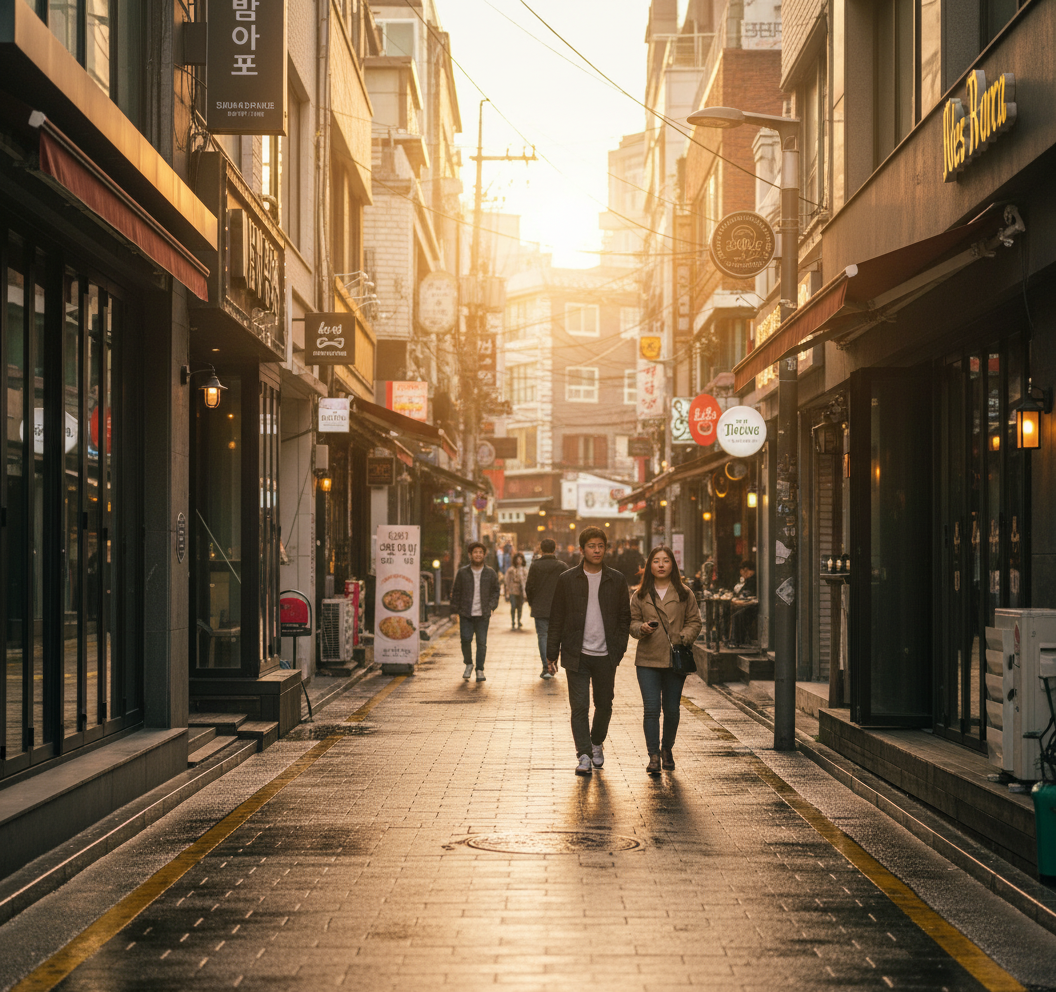
The main Itaewon street runs uphill from Itaewon Station (이태원역) on subway Line 6. The lower section near the station is the densest concentration of bars, international restaurants, and fashion stores — active from early evening through the early morning hours. The upper section toward Noksapyeong Station (녹사평역) is calmer, with a growing concentration of independent cafés and concept stores.
What Makes Itaewon Different from the Rest of Seoul
Walking Itaewon for the first time, several things immediately distinguish it from Seoul's other major neighborhoods:
Language: English is genuinely usable here. Many restaurant menus are in English first. Staff at most establishments are accustomed to non-Korean-speaking customers. Prices are sometimes displayed in USD alongside Korean won at bars catering to international visitors.
Food diversity: No other neighborhood in Seoul comes close to Itaewon's international food range. Within a ten-minute walk of the station, you can find Turkish kebab, Lebanese mezze, Ethiopian tej bars, Pakistani curry, Japanese izakaya, American-style brunch, authentic Mexican tacos, Vietnamese pho, and Indian vegetarian thali — alongside excellent Korean restaurants that cater to an international palate.
Nightlife culture: Itaewon's clubs and bars are more mixed, more international, and more socially open than anywhere else in Seoul. The district has historically been home to Seoul's most visible LGBTQ+ scene and continues to maintain that culture.
🍽️ Food: What to Eat in Itaewon
International Restaurants
Vatos Urban Tacos (바토스): Korean-Mexican fusion tacos that have become a Seoul institution. The kimchi carnitas burrito is a signature dish. Itaewon branch is regularly packed; reservations recommended for weekends.
Wolfhound Irish Pub: One of Seoul's best-known expat institutions, serving proper Guinness pints and Irish-influenced pub food. Good for watching international sports broadcasts.
Craftworks Taphouse: Seoul's craft beer culture has its roots in Itaewon, and Craftworks remains one of the finest dedicated craft beer bars in the city. Rotating Korean and international taps, solid food menu.
Linus BBQ: Texas-style smoked barbecue from an American pitmaster who settled in Seoul. The brisket and pulled pork are the real thing. A short walk from the main strip toward Haebangchon.
Plant (플랜트): Fully plant-based Korean and Western menu, popular with Seoul's international vegan community. One of the best vegan restaurants in the city.
Halal Food in Itaewon
Itaewon is the primary destination for Halal food in Seoul, driven by the large Muslim community — including both Korean Muslims and international residents — centered around the Seoul Central Masjid (서울중앙성원), Korea's largest mosque, which sits on the hill above the main street.
The streets immediately around the mosque contain a dense cluster of Halal-certified restaurants: - Turkish restaurants: Authentic lahmacun, döner, and grilled kebab - Pakistani and South Asian curry houses: Several family-run establishments with full Halal certification - Malaysian and Indonesian restaurants: Growing presence around the mosque area
For Muslim travelers, Itaewon is effectively the only neighborhood in Seoul where eating without extensive ingredient verification is practical and stress-free.
The Antique Furniture Street (앤틱가구거리)
Running behind the main Itaewon strip toward the hillside is a less-known but fascinating cluster of antique furniture and vintage goods shops — Seoul's antique district. Korean furniture makers and dealers occupy multi-floor warehouses selling traditional Korean chests (반닫이, bandaji), ceramic pieces, traditional screens (병풍, byeongpung), and vintage porcelain. Whether buying or just browsing, it is one of the most distinctive shopping experiences in Seoul.
☕ Hannam-dong (한남동): Upscale and Design-Focused
A short walk east from the main Itaewon strip, Hannam-dong has in recent years become one of Seoul's most desirable addresses for upscale independent retail, gallery spaces, and premium cafés. The Leeum Samsung Museum of Art (리움미술관) — one of Korea's finest private art collections — anchors the neighborhood culturally.
Key Hannam-dong Highlights
Leeum, Samsung Museum of Art (리움미술관): An architectural landmark as much as a museum — the building itself is a collaboration between three internationally renowned architects (Mario Botta, Jean Nouvel, Rem Koolhaas). The permanent collection spans Korean ceramics from the Three Kingdoms era through contemporary Korean and international art. Free entry on selected days.
Hannam-dong café strip: The streets radiating from the Hannam-ro (한남로) main road are lined with some of Seoul's most carefully designed independent cafés — specialty roasters, dessert concept stores, and multi-story café buildings. This is where Seoul's design industry comes to work and be seen.
Boutique shopping: Hannam-dong hosts a number of Seoul-exclusive independent fashion boutiques and the Korean flagships of international concept brands. Less touristic and more design-industry-oriented than Garosu-gil.
🏘️ Haebangchon (해방촌, HBC): Seoul's Bohemian Quarter
Haebangchon — known to its international resident community as HBC — occupies the hillside between Itaewon and Namsan, a neighborhood of narrow streets, low-rise buildings, and a long-established community of international residents including many English teachers, artists, and writers who built a neighborhood character quite unlike anywhere else in Seoul.
HBC has its own restaurant scene — more personal, less commercial than the main Itaewon strip:
- Homemade restaurants run by international residents serving cuisines from their home countries: South African braai, Filipino home cooking, Brazilian churrasco
- Independent bars with live music nights, quiz nights, and the atmosphere of neighborhood locals rather than tourist venues
- Sunset views: The HBC hillside offers some of the best informal sunset viewing spots in Seoul, with wooden benches and views over the city
The Gyeongnidan-gil (경리단길) Sub-district
Running parallel to the hill between Itaewon and Noksapyeong, Gyeongnidan-gil was Seoul's most celebrated independent restaurant street in the early 2010s, pioneering the concept of chef-driven casual dining before the trend spread citywide. The original wave of restaurants has partly given way to newer concepts, but the street still has excellent independent food options and retains its neighborhood-rather-than-tourist character.
🌙 Nightlife
Itaewon's nightlife is the most internationally diverse in Seoul — and the most late-night. The district's clubs and bars operate on a schedule several hours behind the rest of the city, with peak atmosphere between 1AM and 4AM.
Club Scene
Cakeshop: One of Seoul's premier underground electronic music venues. Small, dark, and internationally booked DJs. The line on weekends requires patience; arriving before midnight speeds entry.
Soap: Adjacent to Cakeshop and operating with the same underground ethos, Soap has become a benchmark venue for Korean electronic music culture. Both venues are known for their inclusive, international atmosphere.
VENUE: A larger format club playing mainstream EDM and K-pop remix sets for a mixed Korean and international crowd. Higher commercial energy than Cakeshop or Soap.
Bars
The bar scene in Itaewon covers every format: sports bars, craft beer pubs, rooftop cocktail bars, Hookah lounges, and quiet wine bars in Hannam-dong. The main strip is loud and social; the Hannam-dong side streets are more intimate.
Safety note: Itaewon is generally safe, but the combination of alcohol and a late-night crowd means standard city common sense applies: watch your belongings, use KakaoTaxi to get home, and don't leave drinks unattended.
🕌 Seoul Central Masjid (서울중앙성원)
The Seoul Central Masjid — Korea's largest mosque — sits at the top of the hill above the Itaewon main street. Built in 1976 with funding from Middle Eastern countries in exchange for Korean construction workers' labor in the Gulf region, the mosque is architecturally distinctive against the Seoul skyline and serves a community of approximately 200,000 Muslims in Korea.
Non-Muslim visitors are welcome to view the exterior and enter the grounds during non-prayer times. The neighborhood immediately surrounding the mosque is the most international street-food cluster in Seoul, worth visiting for the Turkish simit (ring bread), kebab wraps, and Middle Eastern sweets regardless of faith.
🚇 Getting to Itaewon
By Subway
Line 6 (갈색선, brown): Itaewon Station (이태원역), Exit 1 or 2. From central Seoul hubs: - From Myeongdong (명동): 2 stops, approximately 8 minutes - From Hongdae (홍대입구): 4 stops with one transfer (Line 2 → Line 6 at Gongdeok), approximately 15 minutes - From Gangnam (강남): Transfer at Samgakji (삼각지) on Line 6, approximately 20 minutes
Noksapyeong Station (녹사평역) on the same Line 6 is the alternative entry point, closer to the upper Itaewon hill and Haebangchon. The walk between Itaewon Station and Noksapyeong Station along the main road (approximately 15 minutes) is itself a complete mini-tour of the neighborhood.
⏰ Best Time to Visit
❓ Frequently Asked Questions
Q1: Is Itaewon safe for solo female travelers? The main Itaewon strip and Hannam-dong are generally safe, including during evening hours. Late-night club areas require the same awareness as any nightlife district in any major city. Staying aware of your surroundings and using KakaoTaxi rather than street taxis late at night is the standard recommendation.
Q2: Is English widely spoken in Itaewon? Yes — more than in any other Seoul neighborhood. Most restaurants and bars on the main strip have English-speaking staff, English menus, and genuine experience serving international guests. Itaewon is the easiest neighborhood in Seoul to navigate without any Korean language ability.
Q3: What happened to Itaewon after the 2022 tragedy? The October 2022 crowd crush in Itaewon (이태원 참사) claimed 159 lives and deeply affected the neighborhood's energy for an extended period. The area has since recovered commercially and socially, and a memorial commemorating the victims has been established near the site. Visitors should be aware of the event's significance and approach the neighborhood with respect.
Q4: Is Itaewon good for shopping? For specific categories — international fashion brands, vintage clothing, antique Korean furniture, specialty food imports — yes. For mainstream Korean fashion and cosmetics, Myeongdong and Hongdae have better selection and prices. Itaewon's shopping strength is its internationality and the independent boutiques of Hannam-dong.
Q5: What is the best neighborhood to stay in near Itaewon? Itaewon itself has several international-chain and boutique hotels. For first-time visitors, Myeongdong or Hongdae-area accommodation is more centrally positioned for daytime sightseeing, with Itaewon easily accessible by subway for evenings. If your primary interest is the international food scene and Hannam-dong culture, staying in Itaewon directly makes excellent sense.