Korean Drinking Culture Guide 2026: Soju, Makgeolli, Hof & Bar Etiquette
Updated for March 2026
Korea has one of the world's most distinctive and socially codified drinking cultures — and one of the highest per-capita alcohol consumption rates in Asia. Drinking in Korea is rarely done alone and rarely done quietly. It is embedded in the rhythms of social life: after work with colleagues (회식, hoesik), late at night with friends watching football, at tent bars in the rain with strangers who become temporary acquaintances, on the grass of a Han River park in summer.
Understanding Korean drinking culture — the drinks, the customs, the spaces, and the unspoken rules — is both practically useful for any traveler spending evenings in Korea and genuinely interesting as a window into Korean social values.
🍶 The Drinks
Soju (소주)
Korea's national spirit — a clear, neutral-tasting distilled liquor traditionally made from rice, now more commonly from sweet potato or tapioca starch. It is the best-selling spirit in the world by volume, largely because Koreans drink extraordinary amounts of it.
Alcohol content: Standard soju is 16–25% ABV. The trend over the past decade has been toward lower-ABV "soft" soju (16–17%), which has accelerated mass consumption.
Price: A 360ml bottle of standard soju (Chamisul, Chum-Churum, Jinro) costs ₩1,700–2,000 at a convenience store and ₩4,000–6,000 at a restaurant or bar.
Major brands: | Brand | ABV | Character | |-------|-----|-----------| | Jinro (진로) | 16–25% | Market leader; clean, neutral | | Chamisul (참이슬) | 16.9% | Smooth; most popular in Seoul | | Chum-Churum (처음처럼) | 16.5% | Slightly sweeter; popular in younger demographics | | Hwayo (화요) | 25–41% | Premium rice soju; significantly more complex | | Andong Soju (안동소주) | 45% | Traditional distilled soju from Andong; artisanal |
Flavored soju: Fruit-flavored soju (딸기, 복숭아, 자몽 — strawberry, peach, grapefruit) has become enormously popular, particularly among younger drinkers. Lower ABV (12–14%) and sweeter than standard soju.
Makgeolli (막걸리)
Korea's traditional fermented rice wine — milky white, lightly carbonated, mildly sweet and tangy, with 6–8% ABV. Made by fermenting steamed rice with nuruk (누룩, fermentation starter), makgeolli is one of Korea's oldest alcoholic drinks and has experienced a dramatic revival among younger urban Koreans over the past decade.
How it's served: In a large aluminum or ceramic bowl, ladled from a communal kettle (주전자) into smaller shallow bowls. The ritual of the kettle and shared bowls is part of the experience.
Makgeolli pairing: The traditional pairing is with pajeon (파전) — savory green onion pancakes — a combination so established that it has its own cultural logic: on rainy days, Koreans say the sound of rain on the roof makes them crave makgeolli and pajeon. Reason given is that the sound resembles the sizzle of pancake batter hitting a hot pan.
Regional varieties: Different regions produce distinct makgeolli styles. Gyeonggi Province (경기도) produces lighter, cleaner versions. The Jeonju (전주) style is richer and more complex. Seoul's craft makgeolli bars now stock dozens of small-batch regional varieties.
Mekju (맥주) — Beer
Korean domestic beer has historically been criticized for blandness — the two major brands (Cass and Hite) are light lagers designed for refreshment rather than complexity. This changed significantly with the craft beer revolution of the 2010s.
Domestic lagers: Cass (카스), Hite (하이트), Terra (테라), Kloud (클라우드). All similar: light, clean, 4.5–5% ABV. Serve extremely cold. Best with fried food.
Craft beer: Seoul now has a thriving craft brewery scene centered on Itaewon and Mapo. The Booth (더부스), Magpie Brewing (까치맥주), Craftworks, and Galmegi Brewing (갈매기브루잉) in Busan are the most established names. IPAs, stouts, and wheat beers are widely available.
Cheongju (청주) and Yakju (약주)
Clear, filtered rice wine — lighter than makgeolli and more delicate. Baekhwasu (백화수복) is the most recognized commercial brand. Increasingly available at specialty makgeolli bars.
Dongdongju (동동주)
A variety of makgeolli in which rice grains float on the surface — slightly more textured and pronounced in flavor than filtered makgeolli.
🍺 Drinking Spaces
Hof (호프집)
The hof (from German Hofbräuhaus) is Korea's signature casual drinking establishment — a pub-style space serving draft beer (생맥주) alongside fried chicken, dried squid (마른안주), and bar snacks. Every residential neighborhood in Korea has several hofs. They are unpretentious, loud, and the center of the Korean after-work drinking culture.
What to order: A pitcher (피처) of draft beer + fried chicken (후라이드 치킨) is the standard combination. Dry snacks (마른안주) — dried squid, peanuts, fish crackers — come automatically.
Pojangmacha (포장마차)
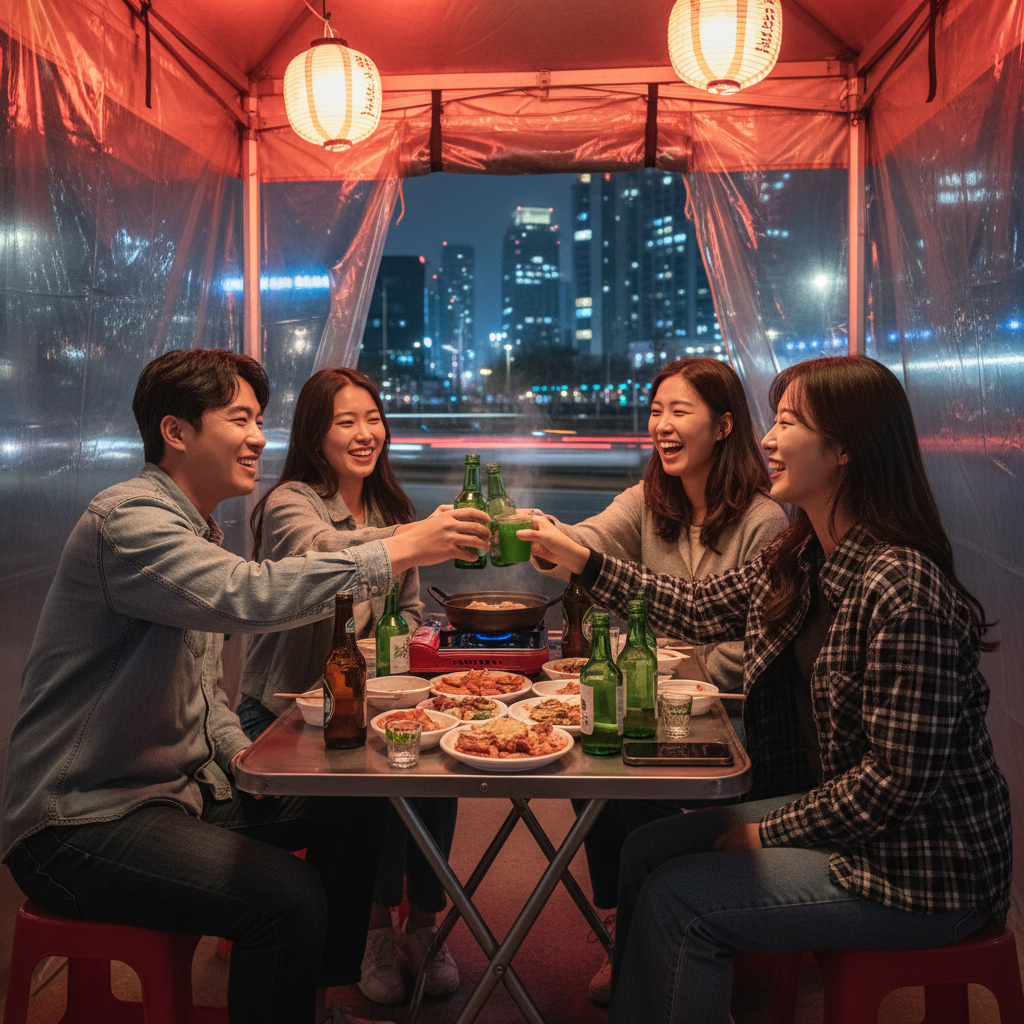
Tent bars — covered street stalls where customers sit at low tables under orange vinyl canopies, eat tteokbokki and soondae, drink soju or makgeolli, and experience one of Korea's most genuine social spaces. Pojangmacha are particularly atmospheric in autumn and winter, when the glow of the heaters inside the tent contrasts with the cold outside.
Best locations: The Jongno-3ga (종로3가) area in central Seoul has the most famous pojangmacha concentration — active from evening through the early morning hours.
Makgeolli Bar (막걸리 바)
A newer category — craft makgeolli bars, particularly concentrated in Hongdae, Mapo, and Insadong, offering regional makgeolli varieties alongside traditional pajeon and modern small plates. These are significantly more curated experiences than the traditional makgeolli tent.
Norebang (노래방) — Karaoke Rooms
Not a bar exactly, but inseparable from Korean drinking culture. Private karaoke rooms rented by the hour, equipped with a song catalog of Korean and international music, tambourines, and a service button for ordering more beer and snacks. Norebang follows dinner and drinks as the standard third stage of a Korean night out (1차 dinner → 2차 bar → 3차 norebang).
🥂 Drinking Etiquette (술자리 예절)
Korean drinking has a rich set of social rules — most of which are rooted in Confucian age hierarchy. Knowing them signals cultural awareness.
Pour for Others, Not Yourself
Never pour your own drink. Always pour for the person next to you, and wait for someone to pour for you. Filling your own glass is considered poor form.
Two Hands
When receiving a drink poured by someone older or senior, hold your glass with both hands — or at minimum support your pouring hand with the other at the elbow. This applies in reverse: pour for elders/seniors with two hands on the bottle.
First Shot Together
The first shot of the evening is typically done together — everyone waits until glasses are full, makes eye contact, says 건배 (geonbae, cheers) or the more formal 위하여 (wiha-yeo, to us), and drinks.
Don't Let Glasses Stay Empty
An empty glass at the table means it should be refilled. In company, leaving a senior's glass empty longer than necessary is a social oversight.
Turning Away to Drink
When drinking in the presence of elders or superiors, it is polite to turn your head slightly away from them when taking a sip — a gesture of modesty in Confucian custom. This is less strictly observed among peers of similar age.
Bomb Shots (폭탄주, Poktanju)
The Korean tradition of dropping a shot glass of soju into a glass of beer — known as somaek (소맥, soju + mekju) — is the universal session lubricant. The combination is smoother than straight soju and stronger than straight beer. Mixing ratios are debated seriously.
📍 Where to Drink in Seoul
❓ Frequently Asked Questions
Q1: Is it rude to decline drinking in Korea? In formal business or senior settings, refusing entirely can be awkward, but it is increasingly accepted — particularly if you clearly explain you don't drink (저는 술을 못 마셔요, jeo-neun sul-eul mot ma-syeo-yo). Having a glass in hand and participating in the social ritual matters more than actually drinking. In casual settings among friends, no pressure exists.
Q2: What is the legal drinking age in Korea? 19 Korean age (만 19세) — which typically corresponds to 18 years old by international standards due to Korea's age-counting system. ID is rarely checked at convenience stores but more often at bars and clubs.
Q3: Is public drinking allowed in Korea? Yes — drinking in parks, on the Han River, and in other public spaces is legal and common. The concept of an open container law does not exist in Korea. Public intoxication is socially acceptable within reason; disruptive drunkenness is not.
Q4: How do I order soju at a convenience store? Walk to the refrigerated section, pick up a bottle of Chamisul or Jinro (they are unmistakable — clear bottles with green or light blue labels), and pay at the counter. No special procedure needed. Convenience stores also sell small plastic soju cups and disposable chopsticks for park drinking.
Q5: What is the best hangover cure in Korea? The Korean hangover culture is an industry. Haejangguk (해장국) — a hearty broth-based soup (most famously haejang-guk, congee, or spicy bean sprout soup) — is the traditional morning cure. The commercial Condition (컨디션) and Morning Care (모닝케어) drinks, sold everywhere, are drunk before or during drinking to reduce hangover severity. Bacchus (박카스) energy drink is the standard morning-after tonic.