Suwon Hwaseong Fortress: The Best Day Trip from Seoul 2026
Updated for March 2026
Seoul is extraordinary — but after three or four days in the capital, many travelers begin to feel the pull of somewhere different. And yet hopping on a KTX to Busan feels like a commitment. What if you could step out of Seoul entirely, walk the ramparts of an 18th-century UNESCO World Heritage fortress, explore a royal palace, eat in a traditional market, and be back at your Seoul hotel by dinnertime?
That is exactly what a day trip to Suwon (수원) and its extraordinary Hwaseong Fortress (화성) delivers. Located just 45 minutes from Seoul by subway, Suwon is one of the most rewarding half-day or full-day excursions in the entire country — and it is almost completely off the itinerary of travelers who do not know to look for it.
🏯 Hwaseong Fortress: Understanding What You Are Visiting
A Palace City Built in Grief and Ambition
Hwaseong Fortress was commissioned by King Jeongjo (정조), one of the most intellectually gifted rulers of the Joseon Dynasty (조선왕조), and constructed between 1794 and 1796. Jeongjo's motivation was deeply personal: his father, Crown Prince Sado (사도세자), had been imprisoned in a rice chest and left to die by Jeongjo's own grandfather, King Yeongjo (영조), in one of the most tragic episodes in Korean royal history. Jeongjo moved his father's tomb to Suwon and built the fortress city partly as a gesture of filial devotion — a new royal seat that would honor the prince who never became king.
The architect Jeong Yak-yong (정약용) — later famous as a Confucian scholar and social reformer — designed the fortress using a sophisticated blend of Chinese, Japanese, and Korean military architecture, incorporating features then cutting-edge in 18th-century engineering: movable pulleys, standardized modular construction methods, and defensive structures designed to counter both traditional siege tactics and emerging firearms technology.
UNESCO designated Hwaseong Fortress as a World Heritage Site in 1997, citing its outstanding universal value as an example of fortified town planning in East Asia and its remarkably well-preserved state after extensive reconstruction following the damage of the Korean War.
The Scale of the Fortress
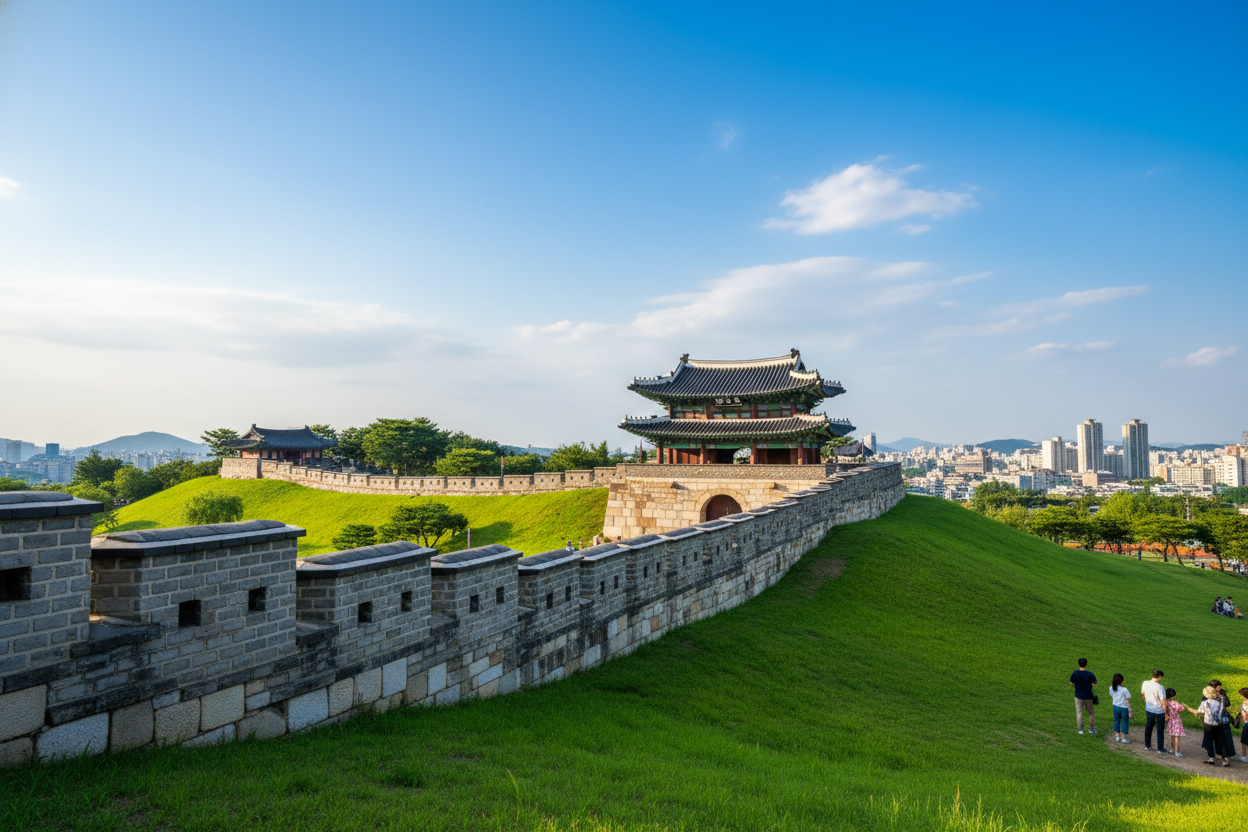
Hwaseong Fortress is not a single building — it is a complete circuit of walls, towers, gates, and bastions that encircles an entire urban district of Suwon. The wall stretches 5.74 kilometers in total length, incorporating:
- 4 main gates: Janganmun (장안문, north), Paldalmun (팔달문, south), Changnyongmun (창룡문, east), Hwaseomun (화서문, west)
- 5 command posts (장대): Elevated platforms for military command with panoramic views
- 4 corner towers (각루)
- 2 water gates (수문)
- Multiple bastions (치성) and secret gates (암문)
The full circuit walk takes approximately 2 to 3 hours at a comfortable pace. You do not need to complete the entire circuit — the northern and western sections offer the most dramatic views and the best-preserved structures.
🚶 Walking the Fortress Wall
The Recommended Route
For a day trip visitor with 2 to 3 hours for the fortress, the most efficient and rewarding approach is to walk the western arc of the wall from Janganmun (북문) down to Paldalmun (남문) or vice versa. This covers the most scenic sections and includes the most architecturally significant structures.
Hwahongmun Water Gate (화홍문) is arguably the most beautiful single structure in the entire fortress — a seven-arched water gate spanning the Suwoncheon (수원천) stream, with a pavilion rising elegantly above the arches. On a clear day with the stream flowing beneath, it is one of the most photographed spots in Gyeonggi Province and justifies the trip on its own.
Banghwasuryujeong Pavilion (방화수류정) — also called the Flower-Visiting Pavilion — is a pavilion perched at the northeast corner of the walls with sweeping views over the water gate and surrounding parkland. Its irregular hexagonal form is unique in Korean pavilion architecture and was deliberately designed to harmonize with the curve of the stream below.
Seojangtae (서장대) on the western hill is the highest of the fortress's command posts and offers the most expansive views of the entire fortress circuit, the city of Suwon, and on clear days, the surrounding Gyeonggi countryside.
Admission and Practical Information
- Adult admission: ₩1,000 (approximately $0.70) — one of the cheapest cultural admissions in Korea
- Opening hours: The fortress walls themselves are accessible around the clock, but the main gates and command posts have staffed hours (approximately 9AM–6PM, longer in summer)
- Fortress Train (화성어차): A tourist train runs a circuit around the fortress perimeter for those who prefer not to walk. Cost approximately ₩4,000 for adults; departs from near Yeonmudae (연무대, eastern command post)
Expert Tip: The fortress is beautiful in all seasons, but it is particularly dramatic in winter when snow covers the battlements against a gray sky, and in autumn when the trees along the wall circuit turn gold and red. Spring mornings before 9AM — before tour groups arrive — offer the most peaceful experience.
🏛️ Haenggung Palace: The Temporary Royal Residence
Directly inside the fortress walls is Hwaseong Haenggung (화성행궁) — a palace complex that served as the temporary residence of the royal court when it traveled from Seoul to Suwon for ceremonies honoring Crown Prince Sado's tomb. At its peak, the complex contained 576 rooms across multiple buildings, making it the largest temporary royal palace in Joseon history.
The palace was heavily damaged during the Japanese colonial period and Korean War, but extensive reconstruction work completed in the 1990s and 2000s has restored the core structures to their 18th-century appearance. Wandering through the courtyards and halls gives a vivid sense of the scale and dignity of Joseon royal architecture outside of Seoul's grander palaces.
- Admission: ₩1,500 for adults
- Cultural performances: The palace grounds host changing of the guard ceremonies (수문장 교대식) at scheduled times — check the Suwon tourism website for current schedules
- Combined ticket: A combined ticket for Haenggung + fortress wall is available and recommended
🛒 Suwon Traditional Market & Local Food
Paldalmun Market (팔달문시장)
Clustered around the southern gate of the fortress is Paldalmun Market — a sprawling traditional market that sells everything from fresh produce and dried goods to clothing and household items. It is a working market serving local Suwon residents rather than a tourist attraction, which means the prices are genuine and the atmosphere authentic.
For travelers, the most interesting sections are the food stalls in the covered alleys surrounding the market perimeter. Local specialties to look for:
Wanggatjip Galbijjim (왕갈비찜): Suwon is famous throughout Korea for its galbi (갈비, short rib) dishes. The city's long history as a livestock market town made beef ribs a local specialty, and Suwon-style galbi — marinated, grilled, and served with a distinctive dipping sauce — is considered among the best in the country.
Galbi-tang (갈비탕): Short rib soup, slow-cooked until the meat falls from the bone in a clear, deeply savory broth. A bowl costs approximately ₩12,000–15,000 and is an excellent warming lunch after a morning on the fortress walls.
Instagrammable Alleys
The narrow covered alleys of Paldalmun Market have become unexpectedly photogenic destinations in recent years, with colorful painted walls and an organic tangle of vendors, lighting rigs, and hanging textiles creating an atmosphere that is simultaneously gritty and beautiful.
🚇 Getting There from Seoul
Suwon is among the easiest day-trip destinations from Seoul precisely because no special train booking or advance planning is required — you simply get on the subway.
By Subway (Recommended)
Line 1 (파란선, blue): Suwon Station (수원역) is a direct ride on Subway Line 1 from Seoul Station (서울역). The journey takes approximately 45–55 minutes, departing regularly throughout the day. You do not need to book in advance — T-Money card works directly.
From Suwon Station, the fortress is approximately 2 kilometers away. Options: - Bus: Local buses connect the station to the fortress area (around 10–15 minutes, covered by T-Money) - Taxi: Approximately ₩5,000–7,000 to Janganmun (north gate) - Walk: 25–30 minutes on a pleasant urban route
Fare from Seoul Station to Suwon Station: Approximately ₩2,150 by T-Money.
By KTX/Mugunghwa (Faster)
Korail trains stop at Suwon Station on several routes. The Mugunghwa service from Seoul Station takes approximately 30–35 minutes and costs around ₩2,600. This is marginally faster and useful if you are already at Seoul Station, but not worth seeking out specifically — the subway is more convenient for most travelers.
📅 Recommended Day Trip Schedule
This schedule is comfortable for most travelers and leaves the evening free in Seoul. If you want to walk the complete fortress circuit, add 1.5 hours and depart Seoul earlier.
🎭 Seasonal Highlights
Suwon Hwaseong Cultural Festival (수원화성문화제)
Held annually in October, the Hwaseong Cultural Festival is one of the most spectacular historical reenactment events in Korea. The festival recreates King Jeongjo's royal procession to Suwon in elaborate period costume, with thousands of performers, traditional music, archery demonstrations, and nighttime illumination of the fortress walls. If your travel dates align with October, adjusting your Suwon visit to coincide with the festival is strongly recommended.
Night Illuminations
Throughout the year (and particularly during special festival periods), the fortress walls and gates are illuminated after dark. The night walk along the lit ramparts — particularly around Hwahongmun Water Gate — is a completely different and equally rewarding experience from the daytime visit.
❓ Frequently Asked Questions
Q1: How much time do I need in Suwon? A half-day (4–5 hours from arrival to departure) covers the essential fortress walk and Haenggung Palace. A full day adds the market, a proper lunch, and a complete fortress circuit. Most travelers find that 5–6 hours is the sweet spot — enough to see everything without rushing, but short enough to return to Seoul comfortably.
Q2: Is the full fortress circuit walk difficult? The circuit involves some elevation changes, particularly on the western hill section near Seojangtae. The terrain is manageable for most reasonably fit adults wearing comfortable shoes. The full 5.74km circuit in summer heat requires preparation — water, sunscreen, and starting early. The partial northern circuit is easier and still covers the most scenic sections.
Q3: Can I combine Suwon with other day trips? Suwon combines well with the Korean Folk Village (한국민속촌), located a short bus ride from Suwon Station. The Folk Village is an open-air museum of traditional Korean architecture and crafts, with demonstrations, performances, and replica traditional homes from different regions of Korea. Allow a full day if combining both.
Q4: Is Suwon worth visiting even if I'm not interested in history? Yes. Even travelers with limited interest in historical sites find Hwaseong rewarding for the architecture, the views, and the walk itself. The water gate and pavilion are visually striking regardless of historical context. The traditional market and local galbi restaurants make Suwon worthwhile as a food destination even for travelers who would skip the fortress.
Q5: Are there English signs and information at the fortress? Yes — Hwaseong Fortress is well-equipped for international visitors, with English signage at all major structures, English-language information boards, and English audio guide rental available at the main ticket offices. The Suwon Tourism website also provides English-language visitor guides and current event schedules.