Is Korea Cheaper Than Japan to Travel? (Honest 2026 Comparison)

Korea and Japan are the two most popular destinations in Asia for international travelers — and one of the first questions people ask when choosing between them is: which is actually cheaper? The answer matters because the difference across a week-long trip can run into hundreds of dollars.
Quick Answer
Korea is generally cheaper than Japan to travel, especially for food and intercity transport. For budget travelers who eat local and move between cities, Korea often feels 20–30% cheaper overall — but the gap depends significantly on exchange rates and accommodation choices. The weak Japanese yen has narrowed the difference in recent years, making Japan more competitive on hotels than it used to be. Korea wins clearly on food value and long-distance rail; accommodation is closer to a tie.
The Full Answer
Both Korea and Japan are among the most popular destinations in Asia, and the question of which is cheaper comes up constantly. The honest answer is: it depends on how you travel — but Korea has a consistent edge in most categories.
Here is a detailed breakdown by category.
Accommodation
Korea: - Budget hostel dorm: ₩25,000–45,000 per night (~$18–33) - Budget private room (motel/guesthouse): ₩60,000–100,000 (~$44–73) - Mid-range hotel: ₩90,000–150,000 (~$66–110)
Japan: - Budget hostel dorm: ¥2,500–4,500 per night (~$17–30) - Budget business hotel (private room): ¥6,000–10,000 (~$40–67) - Mid-range hotel: ¥10,000–18,000 (~$67–120)
Verdict: At the dorm level, Korea and Japan are nearly identical — don't expect significant savings here. At the mid-range private room level, Japan has become genuinely competitive due to the weak yen, and in some cases cheaper than Korea for a comparable room. Korean motels offer strong quality-to-price value at ₩60,000–80,000, but this category is effectively a draw rather than a clear Korean advantage.
Food
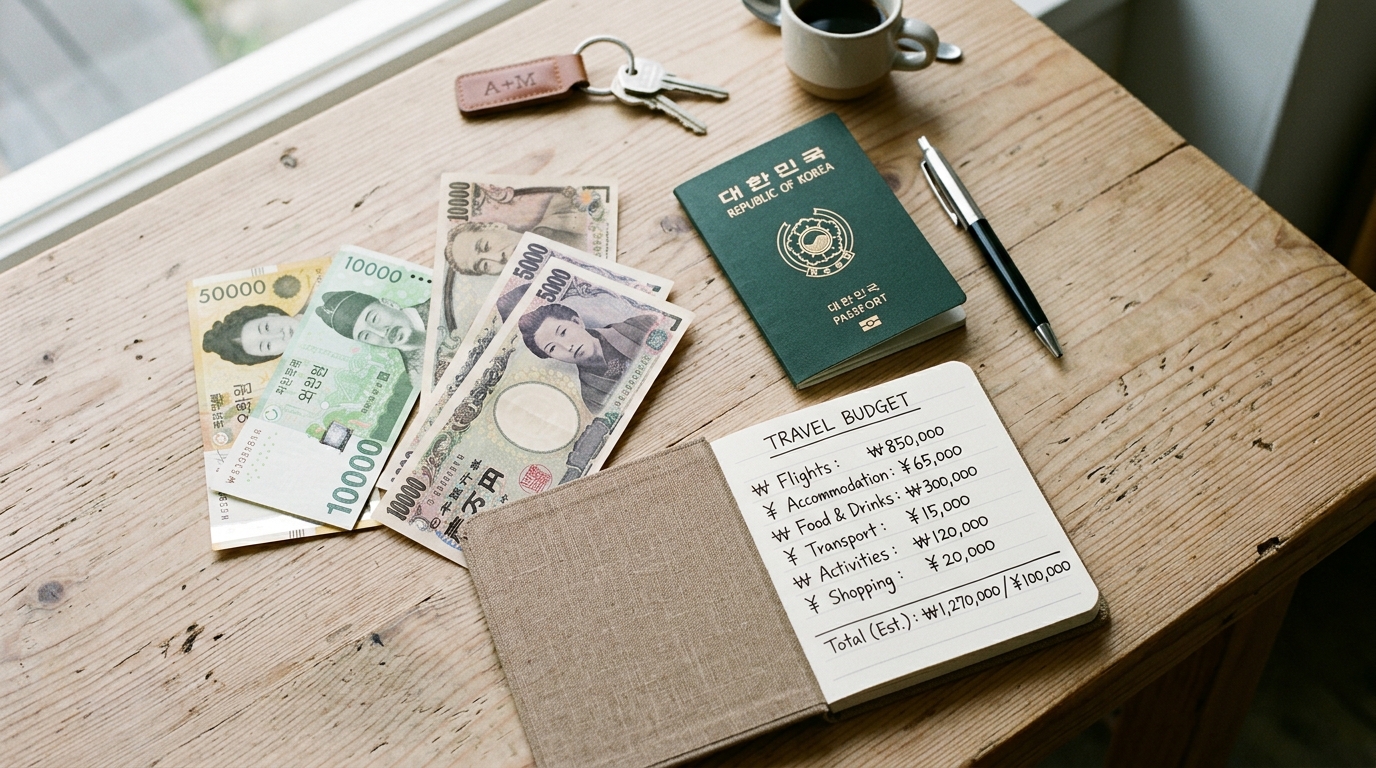
Korea: - Convenience store meal: ₩4,000–7,000 (~$3–5) - Gimbap restaurant set meal: ₩5,000–9,000 (~$3.60–6.60) - Korean BBQ (per person, mid-range): ₩15,000–25,000 (~$11–18) - Café coffee (Americano): ₩5,000–7,000 (~$3.60–5)
Japan: - Convenience store meal: ¥500–800 (~$3.30–5.30) - Ramen at a restaurant: ¥900–1,200 (~$6–8) - Sushi set (kaiten-zushi or casual): ¥1,000–2,000 (~$6.70–13.30) - Café coffee: ¥500–700 (~$3.30–4.70)
Verdict: At the convenience store level, both countries are broadly comparable. The difference shows up at sit-down restaurants. A full Korean meal at a neighborhood restaurant — which typically includes rice, soup, and multiple side dishes (banchan) at no extra charge — runs ₩8,000–12,000 (~$6–9). A comparable casual restaurant meal in Japan usually starts at ¥1,000–1,500. Korean BBQ is significantly cheaper than its Japanese equivalent (yakiniku). Korea is the clear winner for sit-down meal value.
Transport
Korea: - Seoul subway: ₩1,400–1,800 per ride (~$1.00–1.30) - KTX high-speed rail (Seoul–Busan): ₩59,800 (~$44) - Airport rail (AREX, Seoul): ₩4,950–9,500 (~$3.60–7)
Japan: - Tokyo subway: ¥170–320 per ride (~$1.10–2.10) - Shinkansen (Tokyo–Osaka): ¥13,870 (~$92) - Narita Express (airport to Tokyo): ¥3,070 (~$20)
Verdict: City subway costs are similar, though Seoul's subway is slightly cheaper per ride. The biggest difference is intercity travel. The KTX from Seoul to Busan (~2.5 hours) costs around $44, while the Shinkansen from Tokyo to Osaka (~2.5 hours) costs around $92 — more than double. If you plan to travel between cities, Korea is dramatically cheaper. Japan's JR Pass can offer value for extensive travel, but it requires upfront investment and careful planning.
Activities and Attractions
Korea: - Historic palaces (Gyeongbokgung, Changdeokgung): ₩3,000 (~$2.20) each - Most national museums: free - DMZ guided tour: ₩50,000–80,000 (~$37–59) - Namsangol Hanok Village: free
Japan: - Major Tokyo museums: ¥500–2,000 (~$3.30–13.30) - Temples and shrines: often free, some ¥500–1,000 - Universal Studios Japan: ¥8,600+ (~$57+) - Disneyland Tokyo: ¥7,900–10,900+ (~$53–73)
Verdict: Korea's major cultural sites are extremely affordable — most palaces cost less than $3. Japan's cultural sites are reasonably priced too, but theme parks and certain popular attractions add up quickly. Korea wins for cultural attraction value.
Daily Budget Comparison Tables
Budget Traveler (dorm accommodation, local eating)
Mid-Range Traveler (private room, mix of restaurants)
What You Need to Know

The Weak Yen Factor
Since 2022, the Japanese yen has been at historically low levels against the US dollar and euro — at times the weakest it has been in decades. This has fundamentally changed Japan's cost position for Western travelers. Categories like hotels and department store shopping, which used to be clearly more expensive in Japan, are now competitive with or sometimes cheaper than Korea at current exchange rates.
The old assumption — "Japan is expensive, Korea is cheaper" — is still broadly true for food and transport, but no longer holds for accommodation and mid-range spending. Check current exchange rates before your trip rather than relying on older travel comparisons. The gap could widen or narrow further depending on monetary policy in both countries.
Where Japan Is Actually Cheaper Than Korea
- Convenience store food: Japanese convenience stores (especially 7-Eleven Japan) are legendary for quality, and the value is hard to beat even in absolute terms
- Some traditional accommodation: Certain budget ryokan (Japanese inn) experiences are competitively priced relative to Korean hanok stays
- Mid-range hotel rooms: Due to the weak yen, private rooms in Japanese business hotels have become very competitive at the $40–60 range
- Electronics: Japan has historically been a destination for electronics shopping, and while the gap has closed, some items remain cheaper
Where Korea Is Clearly Cheaper Than Japan
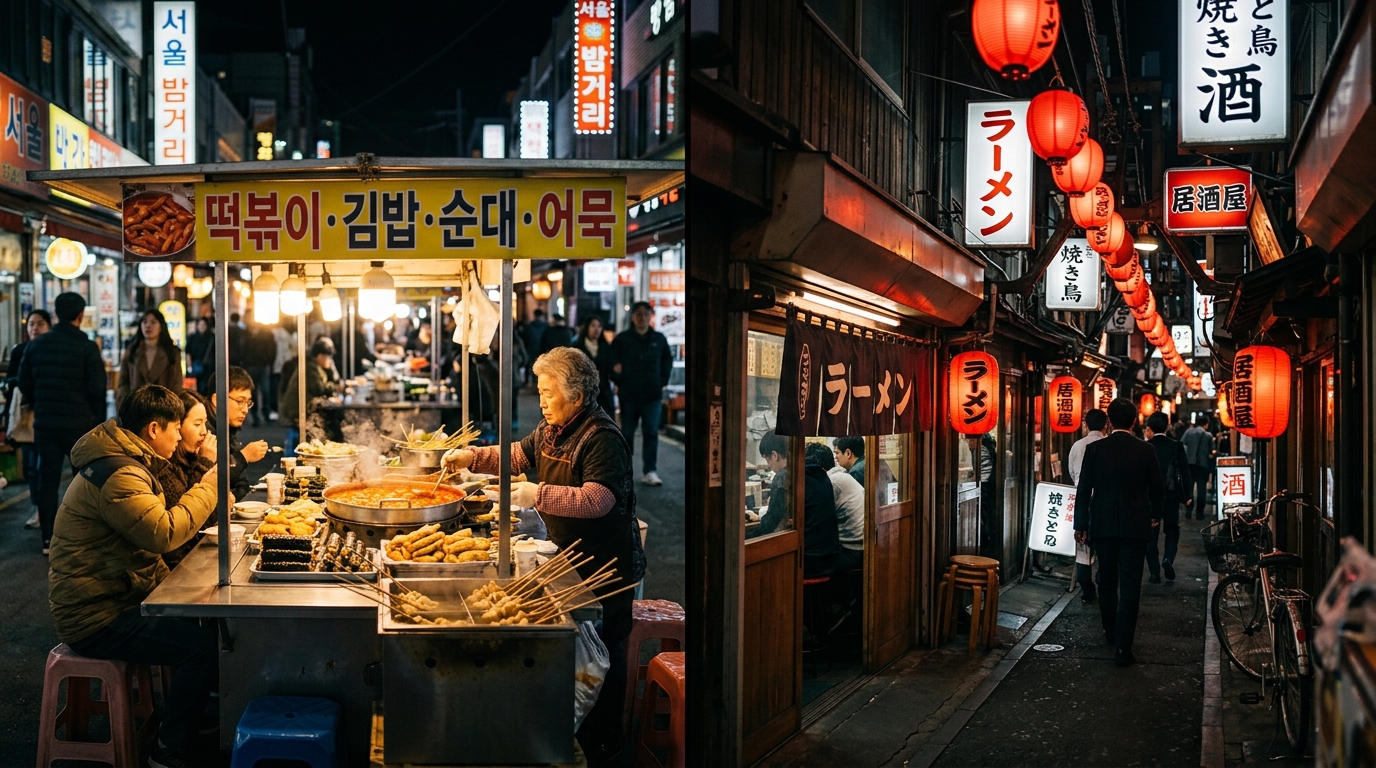
- Street food: Tteokbokki, kimbap, and pojangmacha (street stall) food prices have no direct equivalent in Japan at the same cost
- Korean BBQ vs Yakiniku: Korean BBQ for two with pork belly and sides typically runs ₩30,000–50,000 (~$22–37). Comparable yakiniku in Japan starts at ¥5,000–8,000 (~$33–53) per person
- Intercity rail: As shown above, KTX fares are consistently 40–60% lower than Shinkansen fares for comparable distances
- K-beauty and skincare shopping: Korean cosmetics, sheet masks, and skincare products are significantly cheaper purchased in Korea than Japanese equivalents in Japan
Visa Costs
Most Western passport holders enter both Korea and Japan visa-free for tourism. This is not a differentiating cost factor for the majority of international travelers. Check current visa requirements for your specific passport before traveling.
Tipping Culture
Neither Korea nor Japan has a tipping culture. Service is included. This is a meaningful saving compared to destinations like the United States where 15–20% tips are standard.
Practical Tips
-
Eat where locals eat in Korea. Neighborhood restaurants (sikdang) and underground mall food courts offer full meals for ₩7,000–10,000 including banchan side dishes. This category is where Korea has the clearest budget advantage.
-
Book KTX in advance. Korean high-speed rail is already far cheaper than the Shinkansen, but early booking can secure discounted tickets. Use the Korail website or app.
-
Get a T-money card in Korea. This transit card works on subways, buses, and even some taxis. It slightly discounts fares compared to single-journey tickets and saves time.
-
Use convenience stores strategically in Japan. If you are visiting Japan after Korea, Japanese convenience store food (onigiri, sandwiches, hot items) is where Japan closes the food cost gap with Korea. Stock up for breakfast or lunch.
-
Check the yen rate before you go. The weak yen has changed Japan's budget travel math significantly. Compare current rates to historical norms and factor this into your planning rather than relying on older travel guides.
-
Combine both countries on one trip. Seoul to Tokyo is a short flight (under 2.5 hours). Spending 7–10 days in Korea before crossing to Japan is a popular itinerary that lets you experience both while managing costs by front-loading budget days in Korea.
-
Both beat Western Europe. If you are coming from Europe or North America, both Korea and Japan offer significantly better value than most Western European capitals. Even Japan at its most expensive is cheaper than London, Paris, or Oslo for comparable experiences.