Where to Stay in Jeju Island — Jeju City vs Seogwipo Explained
Quick Answer
Most first-time visitors should stay in Jeju City (제주시), the island's main urban area. It is 10 minutes from the airport, has the widest selection of hotels, restaurants, and transport, and puts you within easy reach of the eastern coastline — Seongsan Ilchulbong, Manjanggul Lava Tube, and Udo Island. Seogwipo (서귀포), on the south coast, is quieter and more scenic — the better choice if you want a slower pace, coastal views from your window, and quick access to Hallasan, the southern waterfalls, and the Olle Trail. The two cities are typically 40–60 minutes apart by car depending on your exact starting point and traffic.
The Full Answer
At 73km east to west, Jeju is compact enough to drive across in under two hours — but where you base yourself still matters. The two main cities sit on opposite sides of Hallasan, the volcanic mountain at the island's center, and each has a distinctly different character.
The choice is not about which is "better." It is about which side of the island your itinerary is weighted toward, and what kind of atmosphere you want at the end of each day.
Jeju City — Best for Most Visitors
Jeju City is where the airport, ferry terminal, and most of the island's practical infrastructure sit. It is the administrative and commercial center of Jeju Island, with a working downtown, a covered market, a fishing harbor, and enough restaurants and cafes to fill several evenings without repeating yourself.
What works in its favor: - The airport is 10 minutes away by taxi (approximately 7,000–10,000 KRW), which makes early departures and late arrivals painless - The eastern highlights — Seongsan Ilchulbong, Manjanggul Lava Tube, Udo Island — are all within 45–60 minutes by car from Jeju City - Bus routes are more frequent here than anywhere else on the island - The Dongmun Traditional Market (동문시장) is one of the best street food markets in Jeju and is a 10-minute walk from most central hotels
What it lacks: - The south coast scenery — Cheonjiyeon Waterfall, Jeongbang Waterfall, Oedolgae Rock — requires a 45-minute drive each way - The city center is functional rather than picturesque; it does not have the dramatic coastal backdrop that Seogwipo does - Budget guesthouses and mid-range hotels are common, but genuinely scenic accommodation is harder to find without going to the coast
Who should stay in Jeju City: First-time visitors, travelers without a car who need bus routes, anyone on a 2–3 day trip where coverage matters more than atmosphere, and travelers who value early airport access.

Seogwipo — Best for Scenery and Slower Trips
Seogwipo is Jeju's second city, but it feels more like a resort town than a city. The south coast faces warmer currents, has a milder microclimate, and is significantly greener than the north — which makes it the preferred base for travelers who want to wake up to views rather than to traffic.
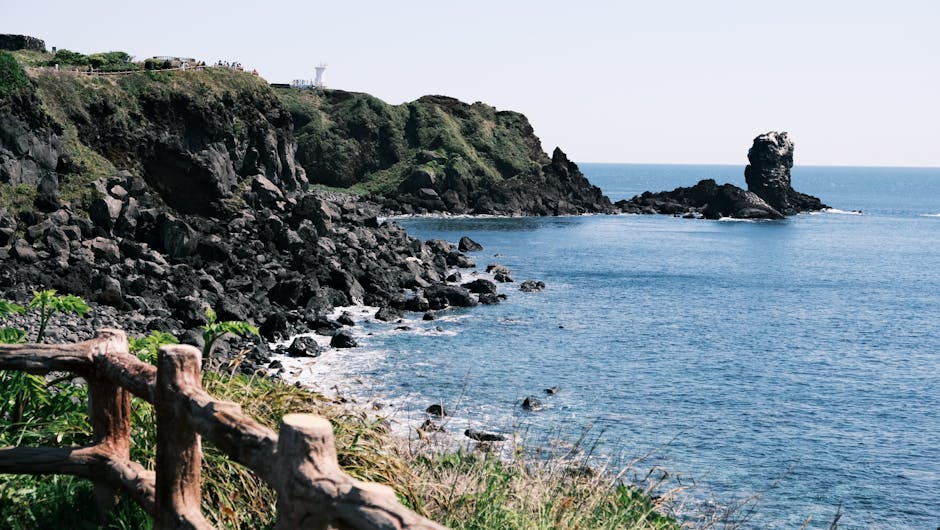
The city itself is built on and around a cliff line above the coast. The three most famous waterfalls in Jeju — Cheonjiyeon (천지연), Jeongbang (정방), and Cheonjeyeon (천제연) — are all within Seogwipo's boundaries. The Olle Trail's most scenic sections run along this coastline. Hallasan National Park's southern trailhead (Yeongshil Course) is approximately 25 minutes away.
What works in its favor: - Many visitors find the south coast to be the most scenic part of Jeju — coastal roads, lava cliffs, and subtropical vegetation - Hotels here often have ocean views that Jeju City hotels simply cannot match - Quieter, less crowded, and easier to move around in on foot near the waterfront - The west coast (Hyeopjae Beach, Hallim Park, Biyangdo Island) is accessible from both cities, though driving time varies depending on your specific accommodation location
What it lacks: - The airport is 40–50 minutes away — a meaningful difference if you have early flights or tight connections - Fewer restaurant options compared to Jeju City; dining is good but the variety is narrower - More car-dependent: buses to eastern highlights (Seongsan, Udo) from Seogwipo involve more transfers and time
Who should stay in Seogwipo: Travelers staying 4+ nights with a car, couples looking for scenic accommodation, anyone specifically targeting the south coast or Olle Trail, and repeat visitors who already know the island.

The Eastern Option — Seongsan Area
If your itinerary is heavily focused on the east — Seongsan Ilchulbong, Udo Island, Seopjikoji — staying in Seongsan (성산읍) itself is worth considering. Small guesthouses and pension-style accommodation are available, and you can walk to the crater in the morning before day-trippers arrive from Jeju City. Accommodation options are limited and fill up quickly on weekends; book well in advance.
What to Know About Accommodation Types in Jeju
Hotels: Major international brands are concentrated near Jeju City and in Seogwipo's Jungmun Resort Complex (중문관광단지), Jeju's purpose-built resort area about 10km west of Seogwipo city center. The Lotte, Shilla, and Hyatt properties here are the island's most upscale options.
Pensions (펜션): The most common accommodation type for Korean domestic travelers — private house-style rentals, typically with a kitchenette, often in scenic coastal locations. Many have minimum 2-night stays on weekends. They range from basic to highly designed, and are often the best value-for-scenery option.
Guesthouses and hostels: Available mainly in Jeju City and near Seongsan. Cheaper but limited amenities. Best booked via Booking.com or Agoda for English-language options.
Price ranges (as of 2026): - Budget guesthouse / hostel dorm: 20,000–35,000 KRW/night - Mid-range hotel (Jeju City): 80,000–150,000 KRW/night - Mid-range pension (coastal, private room): 100,000–180,000 KRW/night - Upscale hotel (Jungmun Resort area): 200,000–400,000+ KRW/night
Rates vary significantly by season. Summer (July–August) and public holiday weekends are peak periods with prices 30–50% higher than shoulder season.
What You Need to Know
- Without a car, Jeju City is the clear choice. Bus routes connect most major attractions from the city, though journey times are long. From Seogwipo, bus access to the eastern highlights involves multiple transfers.
- Peak season booking is essential. Summer weekends, Chuseok, and Seollal see accommodation fill weeks in advance across the island. This applies to pensions most severely — they are in high demand among Korean domestic travelers.
- Jungmun is not Seogwipo city center. The resort complex sits between the two cities and has a somewhat artificial feel — convenient and upscale, but isolated from both the city's practical amenities and the more authentic coastal areas.
- The coastal road connects everything. Route 1132 (일주도로) circles the entire island. Wherever you stay, driving the coastal road in either direction takes you through the main highlights within 30–60 minutes.
Practical Tips
- First-timers: book in Jeju City and rent a car. The combination gives you airport convenience, practical amenities, and the freedom to reach any corner of the island on your own schedule.
- For a scenic base: look for pensions in the Jungmun, Daepo, or Saekdal coastal areas near Seogwipo rather than the city center or the Jungmun Resort Complex itself — better views at lower prices than resort hotels.
- Book weekends at least 3 weeks ahead. Jeju is one of the most popular domestic destinations in Korea. Weekend availability drops sharply, especially for pensions and mid-range properties.
- Check the distance to your top priorities. Use Kakao Map to calculate driving time from a specific hotel to Seongsan Ilchulbong or Hallasan — it varies more than you'd expect depending on the exact location.
- Avoid booking in Jungmun if you don't have a car. The resort complex is not walkable to either city center, and taxis add up quickly over a multi-day stay.
- Airbnb and domestic platforms (Naver Stay, Yanolja) often list pensions that international booking sites miss. Naver Stay in particular has a large inventory of Jeju pensions, though the interface is Korean-only.
Frequently Asked Questions
Is Jeju City or Seogwipo better for a 3-day trip? Jeju City. With only 3 days, the airport proximity saves time on arrival and departure, and the city gives you better access to transport and restaurants when you are not driving. You can reach Seogwipo's south coast highlights as day trips within 45 minutes each way.
Do I need a car to stay in Seogwipo? Strongly recommended. Buses connect Seogwipo to Jeju City and the main tourist sites, but frequency is lower than from Jeju City, and connections to the eastern coast (Seongsan, Udo) involve significant transit time. Without a car, Seogwipo works best if your entire itinerary is focused on the south and west coast.
Where is the best area to stay in Jeju near the beach? For beaches, the north coast (Iho Tewoo Beach, Hamdeok Beach) is closer to Jeju City and easily reachable by bus. On the south coast, Jungmun Beach and Hwasun Beach are near Seogwipo. Hyeopjae Beach on the west coast has some of the clearest water on the island but is a similar driving distance from both cities, though exact times depend on your accommodation location.
Is accommodation in Jeju expensive? Compared to Seoul, yes — especially for beach-adjacent or view properties. Mid-range hotels in Jeju City (80,000–150,000 KRW/night) are similar to Seoul prices, but coastal pensions with genuine views often cost 100,000–200,000 KRW/night. Budget options are available in Jeju City, but scenic budget accommodation is limited island-wide.