Jeju Island Itinerary: 3-Day and 5-Day Options for First-Timers
Quick Answer
Three days is the minimum workable time for Jeju Island — enough to cover the east coast highlights, Seongsan Ilchulbong (성산일출봉), and Manjanggul Lava Tube (만장굴) without feeling rushed. Five days is the better choice if you want to add Hallasan (한라산), the west coast beaches, and at least one slow afternoon. Both itineraries below are structured around real driving distances and realistic pacing.
The Full Answer
Jeju Island (제주도) sits approximately 85 km south of the Korean mainland — a 50-minute flight from Seoul Gimpo or a roughly 13-hour overnight ferry from Mokpo. Its 1,849 square kilometers contain Korea's tallest mountain, three UNESCO World Heritage sites, a distinct volcanic landscape, and a seafood tradition driven by haenyeo (해녀) — the island's female free-divers who have worked these waters for centuries.
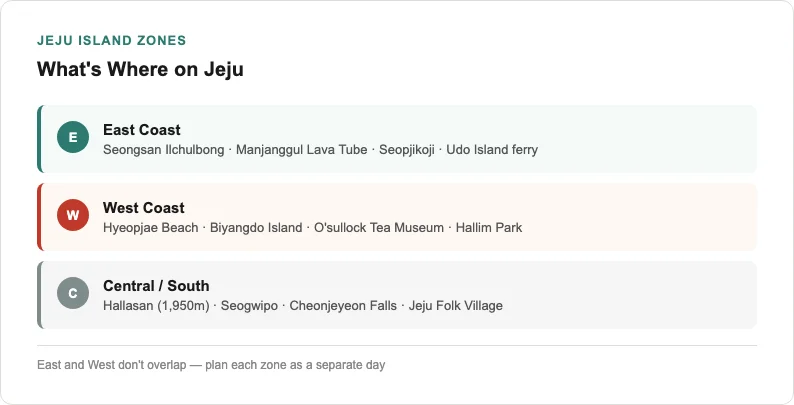
Planning an itinerary here is more logistical puzzle than travel fantasy. The island is roughly circular, with a circumference of approximately 180 km. Attractions cluster on the east coast, the west coast, and the central mountain zone — and they don't overlap. A day spent doing the east side (Seongsan, Manjanggul) leaves the west side untouched. A Hallasan hike takes a full day on its own. That geographic spread is why "just a weekend" tends to disappoint first-timers, and why the question of how many days to spend here actually has a defensible answer.
The itineraries below are organized by what is geographically logical. They assume car rental — the practical default for most travelers — with notes on where buses and tours work as alternatives.
How Many Days Do You Need in Jeju?
Three days is the minimum that travel guides across the board endorse — and not loosely. Under three days, you're doing airport pickups on one end and departure logistics on the other, with two usable mornings in between. You'll see some things, but the island won't feel covered.
Four days gives you the flexibility to handle one major wildcard: bad weather on Hallasan, a ferry delay to Udo Island (우도), or simply the kind of day where you slow down and eat well. It's a significant upgrade over three days.
Five days is the recommended target for anyone who wants the full range: both coasts, Hallasan, an Olle Trail (올레 길) section, and time to actually sit at a Seogwipo (서귀포) cafe and not feel you're falling behind schedule. It's also when the trip stops feeling like a checklist.
Seven days and above opens up multi-section Olle Trail completions, Biyangdo Island (비양도), and the kind of repeated visits to key spots — Seongsan at dawn, Hallasan in autumn light — that define a genuinely good trip. Most first-timers don't need this, but it's worth knowing the ceiling.
Understanding Jeju's Layout — East, West, and Central
Jeju Island divides naturally into four zones. Understanding this before you book anything is the single most useful planning step.
North (Jeju City / 제주시): The main transport hub. Jeju International Airport is here, along with the island's largest concentration of restaurants, accommodation, and Dongmun Market (동문시장). Most visitors start and end here, but there's relatively little in the way of dramatic scenery within the city itself.
East Jeju: The highest concentration of major attractions — Seongsan Ilchulbong, Manjanggul Lava Tube, Seopjikoji (섭지코지) coastal cliffs, and Seongeup Folk Village (성읍 민속마을). These sites cluster within approximately 30 km of each other along the northeast coast, making the east side the most efficient zone to cover in a single day. Intercity Bus 201 connects Jeju City to Seongsan Ilchulbong and then south to Seogwipo, running every 15–30 minutes and covering this corridor well.
West Jeju: Hyeopjae Beach (협재 해수욕장), the tea fields at O'sullock (오설록), Cheonjeyeon Falls (천제연 폭포), and the Biyangdo Island ferry departure point at Hallim Harbour. The west side is less served by public buses and draws meaningfully fewer tourists than the east — which is either a drawback or an advantage depending on your preference. Car rental is essentially required for a full west Jeju day.
Central Jeju (Hallasan): Korea's highest peak at 1,947 meters. The Seongpanak trailhead is approximately 25 km from Jeju City — roughly 30–40 minutes by car. Hallasan is a full-day commitment; it does not share a day with anything else in this guide.
The practical implication: if you're doing three days, you're choosing between the west coast and Hallasan. Five days lets you do both without compromise.
Jeju Island 3-Day Itinerary
This three-day structure prioritizes the east coast and south, which holds the densest cluster of major attractions within the smallest driving distances. It uses Seogwipo as a base from night one — a choice that shortens each morning's commute compared to staying in Jeju City.
Day 1 — Arrival, Jeju City, and South
Morning/Afternoon: Land, pick up your rental car at the airport, and drive directly to Jeju City's Dongmun Market for lunch. The market is open daily and covers two levels of fresh seafood, local produce, and street food — gimbap, haemul pajeon (해물 파전, seafood pancake), and hallabong (한라봉) tangerine juice are standard starting points. Budget approximately ₩10,000–₩20,000 per person (as of 2026) for a market lunch.
From the market, it's worth a 10-minute stop at Samseonghyeol (삼성혈), the founding myth site of Jeju — three holes in the ground from which the island's legendary three ancestors are said to have emerged. Admission is approximately ₩3,000 (as of 2026), and the forested compound is genuinely quiet in the middle of the day.
Afternoon/Evening: Drive south to Seogwipo — approximately 60 km via the coastal route, taking 1–1.5 hours. Check in. Cheonjeyeon Falls is a 15-minute drive from most Seogwipo hotels: three tiers of waterfall connected by walkways, with the Seonimgyo Bridge as a secondary viewing point. Entry is approximately ₩3,000 (as of 2026), and the 30-minute loop is easy enough to do before dinner.
Dinner in Seogwipo: the Maeil Olle Market (서귀포 매일 올레 시장) opens daily and has reliable street food from late afternoon. For a sit-down meal, black pork (흑돼지) restaurants on and around Black Pork Street are the most distinctly Jeju option — budget approximately ₩15,000–₩25,000 per person (as of 2026) for grilled pork with side dishes.
Stay: Seogwipo.
Day 2 — East Jeju Full Day
This is the day most first-timers remember most clearly. The east coast route from Seogwipo covers three substantive sites within roughly 50 km.
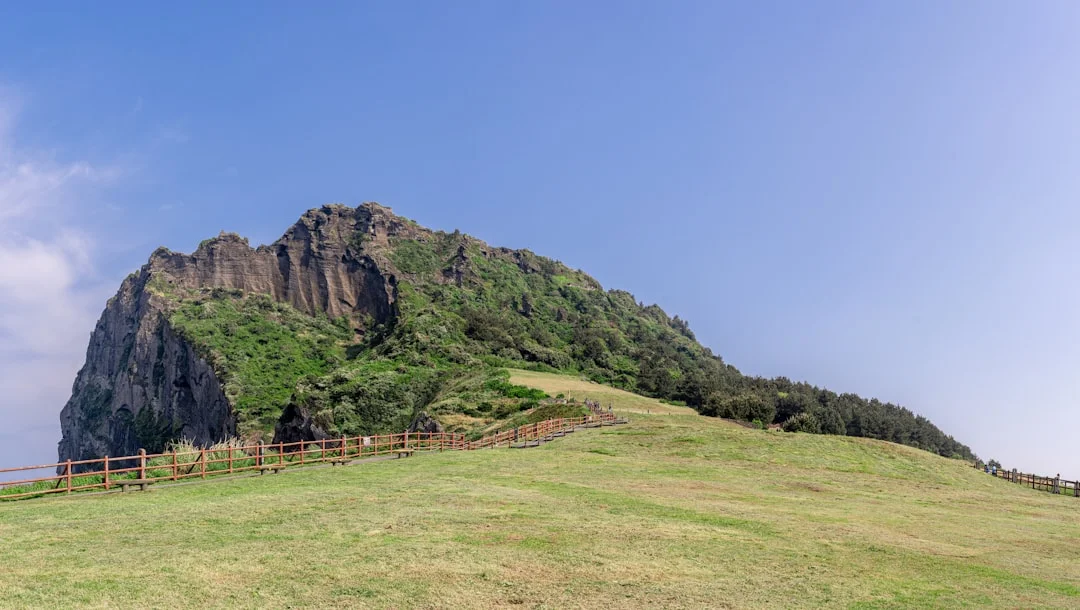
Early Morning (optional): Seongsan Ilchulbong sunrise is one of the more photographed events on the island. The tuff cone sits 182 meters above sea level and the summit trail takes approximately 20 minutes. The catch: you need to be at the base well before sunrise, which means leaving Seogwipo around 4:30–5:00 AM depending on the season. Entry is approximately ₩10,000 (as of 2026) for the summit route; a free lower path exists but doesn't reach the crater rim. If you skip the sunrise, the site is significantly less crowded by 9:00–10:00 AM.
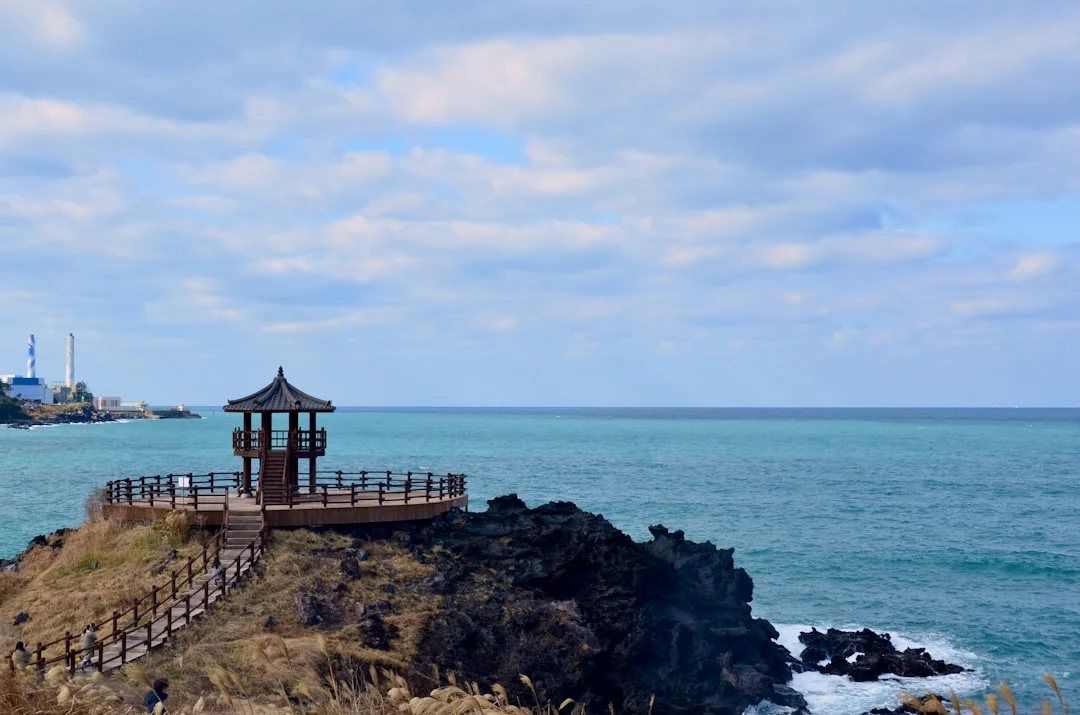
Morning: Whether you went for sunrise or slept in, the Seongsan area rewards time. The crater rim view from the summit is the clearest visual argument for why this is a UNESCO World Heritage site alongside Hallasan and Manjanggul. After descending, Seopjikoji — a coastal headland approximately 5 km south of Seongsan — offers flat walking paths along volcanic cliffs with views across to Udo Island. Entry is free and the loop takes 30–45 minutes.
Mid-Morning to Afternoon: Manjanggul Lava Tube is approximately 15 km northwest of Seongsan — a 20–30 minute drive. At 7.5 km, it's one of the longest lava tubes in the world; the accessible section open to visitors is 1 km. The temperature inside hovers around 11°C year-round, which is welcome in summer and genuinely cold in winter — bring a layer. Entry is approximately ₩4,022 (as of 2026) and the walk takes approximately 30 minutes.
Lunch near Seongsan: Jamae Guksu (자매 국수, also known as Sisters Noodles) is a well-regarded local spot serving gogi-guksu (고기국수) — Jeju's meat noodle soup — for approximately ₩8,000–₩12,000 per bowl (as of 2026). Arrive before 12:30 PM to avoid queues.
Afternoon: Drive back toward Seogwipo. Seongeup Folk Village is roughly midway and worth a short stop if the day is moving easily — traditional thatched-roof houses, some with residents still living in them, and a walking circuit around a reconstructed Joseon-era village. There's no set admission fee, though guided tours are available.
Evening: Haenyeo (해녀) seafood restaurants along the Seogwipo coast offer mulhoe (물회, spicy raw fish soup) and fresh abalone porridge at approximately ₩20,000–₩40,000 per person (as of 2026). The quality of the seafood and the directness of the sourcing — divers, not middlemen — make this worth the slightly higher price compared to mainland options.
Stay: Seogwipo.
Day 3 — Hallasan Hike or Leisure
Three distinct options, and only you can judge which fits.
Option A — Hallasan (한라산) Hike: Early start is non-negotiable. Bus 281 from Seogwipo departs for the Seongpanak trailhead (성판악 탐방로) — a 40-minute ride, approximately ₩1,200–₩1,500 (as of 2026). Alternatively, drive: the trailhead is approximately 30 km from Seogwipo, roughly 40 minutes. The Seongpanak Trail is 18.5 km round-trip, rated the more beginner-accessible of the two summit routes — relatively flat gradient compared to the Gwaneumsa option, though 7–9 hours total is still a full day. The Gwaneumsa Trail (관음사 탐방로) is 8.7 km one-way with 1,380 meters of elevation gain and takes 5–7 hours, but it's steeper and less forgiving on tired legs. Important: online reservation via Visit Halla is free but mandatory — you cannot walk in without it. Entry to the mountain is approximately ₩5,000 (as of 2026). Bring water, snacks, rain gear, and sunscreen regardless of the morning forecast; conditions change quickly at the summit.
Option B — Jeju Folk Village Museum: The Jeju Folk Village Museum (제주 민속촌 박물관) near Pyoseon is a reconstructed traditional village with approximately 100 historic structures, demonstrations, and seasonal festivals. Entry is approximately ₩10,000–₩15,000 (as of 2026) and a thorough visit takes 1.5–2 hours. Combine with Jeju Stone Park (제주 돌 문화 공원) — approximately ₩9,000 (as of 2026) — for a cultural half-day that loops back toward Jeju City for departure.
Option C — Slow morning, Seogwipo Maeil Olle Market, departure: If you're flying out in the afternoon and the previous two days were active, there's nothing wrong with a late breakfast at your hotel, a final walk through Seogwipo's harbor area, and heading to the airport. Jeju City airport is approximately 1.5 hours from Seogwipo — budget accordingly for afternoon flights.
Jeju Island 5-Day Itinerary
Five days allows a structured circuit of the island: north and west first, central mountain on day three, then east, with the final day either slow or focused on the south coast. The base split between Jeju City and Seogwipo reduces backtracking.
Day 1 — Jeju City and North
Morning/Afternoon: Land, pick up rental car, check into Jeju City accommodation. Dongmun Market is the natural first stop — full detail in the 3-day section above. From the market, Samseonghyeol takes 10 minutes. If you have the afternoon, Jeju Stone Park is approximately 8 km east of Jeju City — an outdoor park of volcanic rock formations, dol hareubang (돌하르방) statues, and mythological recreations across open grounds. Budget 1.5 hours.
Evening: Dinner on Black Pork Street (흑돼지 거리) in Jeju City. Dombedon (돔베돈) is frequently cited as a reliable choice among the street's many options. Black pork here refers to a specific Jeju breed — the meat has a higher fat marbling than standard pork belly, and the flavor difference is noticeable compared to what you'll find in Seoul.
Stay: Jeju City.
Day 2 — West Jeju Full Day
Morning: Drive west from Jeju City to Hyeopjae Beach — approximately 45 km, 45–60 minutes. Hyeopjae is Jeju's most photographed west-coast beach: white sand, shallow water that turns turquoise in clear conditions, and a view across to Biyangdo Island. The water is warm enough for swimming from late June through early September; outside those months it's a walking and photography destination.
Mid-Morning: The Biyangdo ferry departs from Hallim Harbour (한림항), approximately 5 km north of Hyeopjae. The crossing takes 15 minutes; the round-trip ferry fare is approximately ₩8,000–₩12,000 (as of 2026). The island circuit walk takes approximately 1 hour. Biyangdo is small enough that you won't feel rushed, and the absence of cars makes the coastal path genuinely quiet. Check the ferry schedule in advance — summer demand can cause delays, and the last ferry back has a hard cutoff.
Afternoon: O'sullock Tea Museum (오설록) is approximately 20 km east of Hallim — 20–25 minutes by car. The museum complex sits at the edge of a working green tea plantation. Entry to the building is free; tea tastings and beverages in the cafe range approximately ₩6,000–₩8,000 (as of 2026). The field views from the terrace are worth 30 minutes even if tea culture is not your primary interest.
Evening: Return toward Jeju City or transition to Seogwipo depending on where you're staying next.
Stay: Jeju City (nights 1–2), or move to Seogwipo if you want a shorter commute to Hallasan the next morning.
Day 3 — Hallasan Day Hike
This day stands alone. Don't add anything else to it.
Early Morning (8:00 AM start): Drive or take bus 281 from Seogwipo to the Seongpanak trailhead. The Seongpanak Trail is recommended for first-timers: 18.5 km round-trip, 7–9 hours total, flatter than the alternative Gwaneumsa route. The summit sits at 1,947 meters — Korea's highest point — with crater lake views that depend heavily on cloud cover. Autumn (September–November) gives the highest probability of clear summit conditions; summer months, particularly July–August, have high cloud cover due to monsoon conditions.
Pre-trip requirements: Free online reservation through Visit Halla (방문 예약은 반드시 필요). This is not a fee — it is simply mandatory registration. Print or screenshot your confirmation. Entry to the mountain is approximately ₩5,000 (as of 2026); trailhead parking is approximately ₩2,000–₩3,000 per vehicle (as of 2026).
Pack: 2+ liters of water, trail snacks, rain gear (conditions change significantly between the base and summit), sun protection, and layers — the summit is noticeably colder than the base even in summer.
Evening: Return to Seogwipo, eat something substantial, and rest. This is a 7–9 hour physical day.
Stay: Seogwipo.
Day 4 — East Jeju Full Day
Identical structure to Day 2 of the 3-day itinerary, with more flexibility since you're not rushing to catch a flight tomorrow. Full detail in the 3-day section: Seongsan Ilchulbong (sunrise or morning), Manjanggul Lava Tube, Seopjikoji, lunch at Jamae Guksu, optional Seongeup Folk Village, haenyeo seafood dinner.
The difference at five days is that you can genuinely slow down. If the Seongsan summit line is long, you wait. If Seopjikoji is windy and clear, you stay longer. The day has buffer built into it.
Stay: Seogwipo.
Day 5 — South Coast, Olle Trail, or Leisure
Three options again, and you'll know by day five which kind of traveler you've been.
Option A — Jeju Olle Trail Section: The Jeju Olle Trail is a network of 26 coastal and mountain walking routes circling the island, each marked with blue and orange ribbon arrows and stone markers. Individual sections range from approximately 10–16 km and are designed as full-day walks. Route 1 (Siheung → Gwangchigi Beach, approximately 14.9 km) and Route 6 (Seogwipo → Sokhang, approximately 11 km) are frequently cited as accessible starting points. Trail stamps are collected at volunteer-staffed stations along each route; completing all sections earns a passport and medal. Entry is free.
Option B — Seogwipo South Coast and Market: Cheonjeyeon Falls revisit, Seogwipo Maeil Olle Market for a proper browse and lunch, and the coastal walkway near the Seogwipo port. Seogwipo's harbor walkway connects several viewpoints and cafes in under an hour — the kind of morning you don't actually remember in detail but that lands well after several active days.
Option C — Rest, cafes, and slow departure: Jeju has a genuine cafe density problem in the best possible sense — converted container buildings on cliff edges, greenhouse cafes overlooking the sea, rooftop spots with crater views. Pick one, stay for two hours. Drive to the airport.
Note on departure: Jeju City airport is approximately 1.5 hours from Seogwipo on the south coast. For afternoon flights, leave Seogwipo no later than noon if you want a buffer.
Getting Around Jeju
Car Rental — The Default
Renting a car is the option that makes every day more flexible, and on the west side it's genuinely the only practical choice. Rental rates range from approximately ₩45,000–₩70,000/day for economy vehicles to ₩80,000–₩120,000/day for SUVs (as of 2026). February is the cheapest month; July is the most expensive — rates in July can run approximately 3–4 times higher than February low-season pricing, which is a meaningful budget variable. Zero-excess insurance (CDW) adds approximately ₩35,000–₩50,000/day (as of 2026) but eliminates deductible risk on any incident. Popular rental companies with airport pickup include Jeju Angelcar and JejuOne Rent A Car.
Parking is free at the majority of attractions. Some beach parking areas charge approximately ₩1,000–₩3,000 per vehicle (as of 2026).
For detailed guidance on booking, insurance options, and what to expect at the counter, see Renting a Car in Jeju Island.
Public Bus — The Budget Alternative
Jeju's intercity bus system is functional on the main east–south corridor. Bus 201 connects Jeju City to Seongsan Ilchulbong and then south to Seogwipo, running every 15–30 minutes. Bus 202 follows the partial west corridor. Fares range approximately ₩1,200–₩3,000 per trip (as of 2026), payable by cash or T-money card. Transfers are allowed within 40 minutes for up to two additional rides per fare. All buses have free WiFi.
The limitation is geographic: buses serve the main trunk routes. Biyangdo ferry departure, O'sullock Tea Museum, most Olle trailheads, and inland sites require either a car or a private tour connection.
Organized Tours — When They Make Sense
Day tours for the east circuit and west circuit are available through Klook, Trazy, and KKday at approximately ₩80,000–₩150,000 per person per day (as of 2026). The main advantage is hotel pickup and guide commentary; the main disadvantage is inflexibility on timing. For a 3-day trip where car rental feels like too much, one organized east-side day tour plus one car rental day for the west is a workable hybrid.
Where to Stay
Jeju City (제주시) — North
Jeju City is 10 minutes from the airport and the better option for travelers with tight schedules or short trips. The accommodation range is wide, and the Dongmun Market area provides evening food options that don't require driving. The drawback is commute time: the east coast (Seongsan) is approximately 1.5 hours from Jeju City, which adds up across multiple days.
Recommended if: Your trip is 2–3 days, or you're prioritizing airport convenience and west Jeju.
Seogwipo (서귀포시) — South
Seogwipo is calmer, more coastal, and often cheaper for equivalent accommodation. It sits approximately 1.5 hours from the airport but within closer reach of the east attractions, the Hallasan trailheads, and the south coast. The Seogwipo Maeil Olle Market is a daily resource. For any trip of 3 or more days, Seogwipo is the more practical base.
Recommended if: Your trip is 3–5 days, or you're planning Hallasan and east-heavy days.
Split Strategy — Nights 1–2 Jeju City, Nights 3–5 Seogwipo
The most efficient approach for a 5-day trip. Jeju City handles airport arrival and the west Jeju day without backtracking. Moving to Seogwipo on day 3 positions you for Hallasan, east exploration, and the south coast. This isn't mandatory, but it reduces the "long drive back to the wrong end of the island" feeling that plagues single-base itineraries.
What You Need to Know
-
Hallasan reservations are mandatory and free. You must register online through the Visit Halla system before hiking — there is no walk-up option at the trailhead. This is purely a planning requirement, not a cost barrier, but missing it means turning back at the gate.
-
Summer heat and monsoon are real planning factors. July and August bring peak crowds, peak accommodation prices, and — in late June through mid-July — consistent monsoon rain. Hallasan summit cloud cover is high throughout summer. If clear mountain views or beach time in genuinely good weather matters, spring (March–May) or autumn (September–November) are meaningfully better windows.
-
Car rental prices spike sharply in July. The July-to-February price ratio on rental cars can approach 4:1. Budget travelers doing a summer trip should factor this in — a week of car rental in July costs roughly what three weeks would in February.
-
Biyangdo and Udo ferry schedules change seasonally. Summer crowds can cause backups and schedule delays. Check current timetables on the day of travel and have a backup plan if the first ferry is full.
-
West Jeju has almost no public bus service. Hyeopjae Beach, Biyangdo, and O'sullock are all either unreachable or impractical by bus. If you're planning a west Jeju day without a rental car, you're looking at an organized tour or a full-day taxi arrangement — expensive and inflexible.
-
An island-wide daily entry fee has been under discussion since 2023. As of May 2026, this has not been implemented. Monitor the official Jeju Tourism Organization site before travel, as the proposed amount was approximately ₩8,170 per visitor per day.
Practical Tips
-
Book your Hallasan reservation before anything else. Visit Halla reservations open several weeks in advance and popular dates fill up. Do this before you book your flights if Hallasan is a priority.
-
Arrive on a weekday if possible, especially in spring and summer. Weekend and public holiday crowds at Seongsan Ilchulbong can triple normal wait times. A Tuesday or Wednesday Seongsan visit is a different experience from a Saturday one.
-
Carry a T-money card for buses and small purchases. Rechargeable at any convenience store (GS25, CU, 7-Eleven), it covers bus fares, convenience store purchases, and some parking meters. Saves repeated cash counting on transit days.
-
Plan food stops into your route, not around it. Jamae Guksu near Seongsan queues fill by noon. Seogwipo Maeil Olle Market is best in the morning for fresh seafood. Haenyeo restaurants near the coast don't always take reservations. Build eating into the schedule rather than treating it as a flexible variable.
-
Download Naver Map or KakaoMap before you land. Google Maps works on Jeju but is less reliable for Korean road navigation, real-time bus schedules, and local business hours. Naver Map is the default that Korean drivers use; KakaoMap integrates with Kakao T for taxis.
-
Check ferry schedules for Biyangdo and Udo the morning you plan to go. Summer crowd delays are common, and the last ferry back has a firm cutoff. The Biyangdo round-trip ferry costs approximately ₩10,500 (as of 2026); confirm the return schedule at the ticket window before boarding.
-
Leave Seogwipo by noon for afternoon flights from Jeju City. The drive is typically 1.5 hours, but peak season and road construction can push that to 2 hours. Missing a Jeju domestic flight means a rebooking fee and, at peak times, a potential overnight wait.
Frequently Asked Questions
How many days do I really need in Jeju? Three days is the functional minimum — enough to cover the east coast highlights without feeling shortchanged, but with very little margin for delays or slow mornings. Four days adds meaningful flexibility. Five days is the point at which the island starts to feel well-covered rather than efficiently processed.
Is renting a car in Jeju necessary? For the east coast only, you can manage with Bus 201 and organized tours — it's not comfortable, but it's viable. For west Jeju (Hyeopjae, Biyangdo, O'sullock), a car is essentially required. For any trip covering both east and west, or including Hallasan and multiple day trips, car rental is the practical choice rather than the convenient one.
Can I hike Hallasan in a single day? Yes. The Seongpanak Trail is 18.5 km round-trip and takes 7–9 hours; the Gwaneumsa Trail is 8.7 km one-way and takes 5–7 hours. Both require a free online reservation through Visit Halla before arrival — there is no day-of registration. An 8:00 AM trailhead start is the standard advice. The Seongpanak route is more forgiving for first-timers; the Gwaneumsa route gains more elevation and offers more technical terrain.
When is the best time to visit Jeju? Autumn (September–November) is the most consistently recommended window: clear skies, mild temperatures of approximately 15–25°C, lower crowds than summer, and Hallasan foliage. Spring (March–May) is close behind — cherry blossoms in late March to April, canola flower fields along the coastal roads, and good hiking conditions. Summer is viable but crowded and monsoon-affected in late June to mid-July. Winter is the cheapest period — accommodation drops significantly in January and February — but beach swimming is out and some facilities reduce hours.
Should I stay in Jeju City or Seogwipo? For 2–3 day trips: Jeju City — the airport proximity saves time that matters more when days are few. For 3–5 day trips: Seogwipo — closer to Hallasan, the east coast, and the south coast, with a more relaxed atmosphere and generally lower accommodation prices. For 5-day trips specifically: split the stay, with two nights in Jeju City and three in Seogwipo.
What's a realistic budget for a 3–5 day Jeju trip? Per person, excluding international or domestic flights: accommodation approximately ₩60,000–₩150,000/night (~$48–$120 USD, as of 2026); food approximately ₩30,000–₩60,000/day (~$24–$48 USD, as of 2026); car rental approximately ₩70,000–₩100,000/day (~$56–$80 USD, as of 2026) not including insurance. A 3-day trip per person lands at approximately ₩400,000–₩800,000 (~$320–$640 USD, as of 2026) excluding flights. A 5-day trip runs approximately ₩700,000–₩1,400,000 (~$560–$1,100 USD, as of 2026) at the same spending pattern.
Can I do Jeju without a car? Yes, with a narrower itinerary. Bus 201 covers Jeju City–Seongsan–Seogwipo reliably. Organized east and west circuit tours fill most gaps. The tradeoffs are timing flexibility — buses run on fixed schedules, tours run on their own — and geographic range. West Jeju in particular is genuinely difficult without a car. Travelers managing without a car typically see the east coast well and miss the west coast almost entirely.
What food is actually specific to Jeju? Black pork (흑돼지) — a specific Jeju breed with distinct fat marbling — grilled as samgyeopsal or ogyeopsal; haenyeo seafood, particularly raw sea urchin, fresh abalone porridge (전복죽), and mulhoe (물회, spicy raw fish soup); gogi-guksu (고기국수), Jeju's meat noodle soup; and hallabong tangerines (available December–February). These aren't menu items you'll find in the same form on the mainland — eating them in Jeju is the point. For a more complete breakdown, see What to Eat in Jeju Island.