Makgeolli Guide: Types, ABV, How to Drink, and Where to Buy in Korea (2026)
Quick Answer
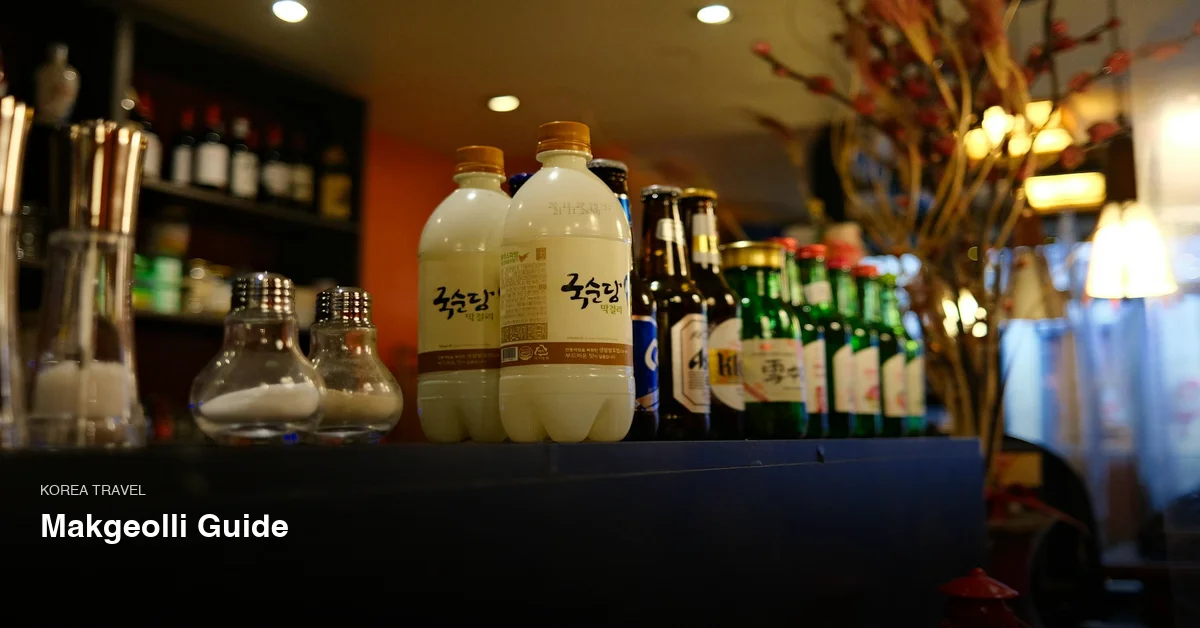
Makgeolli is Korea's oldest alcoholic drink — a milky, lightly fizzy fermented rice wine made from steamed rice, water, and nuruk (a traditional fermentation starter). Most convenience store bottles are 6% ABV, while craft versions range from 9–13%. Gently invert the bottle before pouring, drink it cold from an earthenware bowl, and pair it with pajeon. As of June 2026, a 750ml bottle costs approximately ₩1,600–2,300 at any convenience store.
What Is Makgeolli?
Makgeolli (막걸리) is Korea's oldest surviving alcoholic drink, with a history stretching back to the Three Kingdoms era — at least the 1st century BCE. It belongs to the takju (탁주) category of Korean alcohol, meaning "cloudy liquor." The classification exists in Korean tax law specifically for fermented rice drinks with visible sediment.
The base recipe is simple: steamed rice (쌀), water (물), and nuruk (누룩). Nuruk is the defining ingredient — a fermented cereal cake that contains wild molds producing the enzymes that break down rice starches into fermentable sugars. This use of wild-culture nuruk rather than purified yeast is what gives makgeolli its complex, slightly unpredictable flavor profile, and why regional varieties taste meaningfully different from one another.
The fermentation process takes approximately one week in traditional onggi (옹기) clay crocks. The resulting brew is then roughly filtered through cloth, which is where the name comes from — mak (막) means "roughly" or "carelessly," and geol-li (걸리) means "filtered." The liquid emerges milky off-white with chalky sediment that settles at the bottom over time, and carries a gentle natural carbonation from residual fermentation.
Flavor-wise, makgeolli is simultaneously sweet, tangy, mildly bitter, and slightly astringent — the balance shifts by brand, region, and how long ago it was bottled.

Photo by makafood on Pexels
What Is Dongdongju — and How Is It Different?
Dongdongju (동동주) is closely related to makgeolli and is often confused with it. Both begin with the same ingredients and fermentation process. The difference is in how aggressively they are filtered and how long they ferment.
| Feature | Makgeolli | Dongdongju |
|---|---|---|
| Filtration | Aggressively filtered — no solids | Minimally strained — whole rice grains pass through |
| Appearance | Uniformly cloudy white, smooth | Cloudy with visible floating rice grains |
| Fermentation | Fermented to completion | Harvested earlier, after approximately 2–4 days |
| Dilution | Water added after fermentation | Not diluted |
| ABV | 6–8% | Approximately 10%+ (undiluted) |
| Flavor | Mild sweet-tangy, smooth | Slightly sweeter, clearer, deeper rice character |
| Availability | Widely available at convenience stores and bars | Mainly at traditional restaurants and pojangmacha |
If you order 동동주 at a bar and see visible floating rice grains in your bowl, that is dongdongju. If the liquid is uniformly milky with no solid pieces, it is makgeolli.
Types of Makgeolli
The commercial and craft makgeolli market has expanded significantly since the early 2010s. At a basic level, the categories break down as follows.
Traditional (전통 막걸리): Multi-step fermentation, unfiltered or minimally filtered, drier and more complex. ABV typically 9–13%. Found at specialty stores and traditional makgeolli bars rather than convenience stores.
Commercial pasteurized (살균 막걸리): Mass-produced, heat-treated to kill all active cultures, and often sweetened with aspartame. Shelf life of 12 months or more. The dominant format at most supermarkets. Convenient but stripped of any probiotic value.
Draft/live (생막걸리): Unpasteurized, still actively fermenting at the time of sale, and must be kept refrigerated. Shelf life of 10–30 days. The standard for makgeolli bars and for anyone wanting live cultures. Look for "생(生)" or "saeng" on the label.
Flavored (맛 막걸리): Chestnut (밤), banana, strawberry, peach, yuzu, blueberry, and corn varieties have become increasingly common since 2020. Flavored variants are gentler entry points for first-timers.
Regional and craft: Small-batch productions from specific provinces with distinct identities — Gyeongju, Pocheon, Yangpyeong (Jipyeong), Ulsan (Boksoondoga), and Haenam (Haechang) are the best-known origins.
ABV & Brand Comparison
| Brand | Korean | ABV | Type | Price (750ml, convenience store) |
|---|---|---|---|---|
| Seoul Jangsu Fresh | 서울장수생막걸리 | 6% | Fresh/Draft | ₩1,600–2,000 (as of mid-2024) |
| Jipyeong Fresh | 지평생막걸리 | 6% | Fresh/Draft | ₩1,700–2,300 (as of mid-2024) |
| Kooksoondang Saeng | 국순당생막걸리 | 6% | Fresh/Draft | ₩2,200 (as of mid-2024) |
| Kooksoondang Wuguook | 국순당 우국생 | 6% | Fresh | ₩1,850 (as of mid-2024) |
| Pyeongsaeng | 평생막걸리 | 6% | Fresh/Draft | Approximately ₩1,700 (as of mid-2024) |
| Neurin Maeul | 느린마을막걸리 | 5% | Fresh | ₩3,000+ (convenience store) |
| Naru Saeng | 나루 생막걸리 | 10% | Craft | ₩7,000–10,000 |
| Boksoondoga | 복순도가 | 6.5% | Craft | ₩12,000–18,000 |
| Haechang | 해창막걸리 | 6%, 9%, 12%, or 18% | Traditional | ₩15,000–100,000+ |
All prices in the table above are based on mid-2024 data. As of June 2026, convenience store prices have risen slightly due to general inflation — expect to pay ₩100–300 more per bottle than the figures listed. Specialty shops and traditional markets carry a wider range of craft options at higher price points.
Regional highlights: - Gyeongju Makgeolli / Beopju (경주 막걸리): A dual-use product from Korea's ancient Silla dynasty capital. Pour off the clear top layer as cheongju (청주, clear rice wine), then invert and shake for makgeolli from the same bottle. - Jipyeong (지평): From a 100-year-old brewery in Yangpyeong. One of the fastest-growing national brands, with up to a 30-day shelf life among fresh varieties. - Neurin Maeul / Slow Village (느린마을): No artificial additives, seasonal batch production. The flavor shifts noticeably by season — spring batches are sweeter and fresher, winter batches are drier and stronger. - Haechang (해창): From Haenam in South Jeolla Province. Rich, creamy, with no artificial sweetness. The 18% ABV version is a niche high-ABV product. - Boksoondoga (복순도가): An Ulsan-based prestige craft label with bright, tart, acidic flavor and natural carbonation. Widely available at department stores and specialty shops, and exported internationally.
How to Drink Makgeolli
Before opening the bottle: Gently invert it 2–3 times to redistribute the settled sediment. Do not shake vigorously — the natural carbonation will cause it to overflow. For unpasteurized varieties, open the cap briefly to release built-up gas, close it, and repeat a few times before fully opening.
Temperature: Commercial 6–7% brands should be served cold, at approximately 4–6°C — straight from the refrigerator. Craft and artisanal versions at 9–13% develop more flavor at slightly warmer temperatures (8–10°C). A small number of traditional bars serve warm makgeolli in cooler seasons, though this is not the standard.
The vessel: The traditional serving vessel is a sagi (사기) or sabal (사발) — a shallow, wide earthenware bowl. This is standard at most makgeolli bars and traditional restaurants. At pojangmacha (포장마차, outdoor stalls), larger communal earthenware vessels are sometimes used. The bowl shape lets the lightly fizzy drink breathe and makes it easier to swirl before drinking, which matters because the sediment resettles quickly.
Pouring etiquette: Pour into others' bowls before your own. Use both hands or support the pouring arm with your free hand — the same respectful gesture used for soju. Covering your bowl with your hand is the signal that you are declining a refill.
At a bar: The standard format is a kettle (주전자, jujeonja) holding approximately 700ml–1L, ordered alongside anju (안주) — the side dishes that accompany drinking in Korean culture. The food is not optional; it is part of the experience.
What to Eat with Makgeolli
The canonical pairing for makgeolli is pajeon (파전) — a savory scallion pancake cooked crisp on the outside with a chewy interior. The cultural association runs deep: Koreans traditionally believe makgeolli and pajeon belong together on rainy days. The reasoning is partly sensory (the sound of falling rain resembles oil sizzling in a pan) and partly nostalgic — this pairing has been common across centuries of Korean food culture. Whether you follow the belief or not, the combination works well.
Other reliable food pairings:
| Food | Korean | Notes |
|---|---|---|
| Kimchi pancake | 김치전 (kimchi jeon) | Slightly spicier counterpoint to makgeolli's sweetness |
| Mung bean pancake | 빈대떡 (bindaetteok) | Traditional street food; rich and savory |
| Tofu with stir-fried kimchi | 두부김치 (dubu kimchi) | Very common bar pairing |
| Boiled pork belly wraps | 보쌈 (bossam) | Rich fatty meat cuts through the acidity |
| Moon snail noodle salad | 골뱅이무침 (golbaengi-muchim) | Classic pojangmacha combination |
| Potato pancake | 감자전 (gamja jeon) | Mild and starchy; balances the tang |
The Jeonju experience takes this to a different level. At Samcheon-dong Makgeolli Alley (삼천동 막걸리골목), ordering one kettle per person at ₩5,000 triggers a spread of 8–15 banchan (side dishes) that are continuously refilled throughout the meal. Each additional kettle ordered brings another round of food. The banchan are included in the price of the drink. This is widely considered the best-value makgeolli experience in Korea.
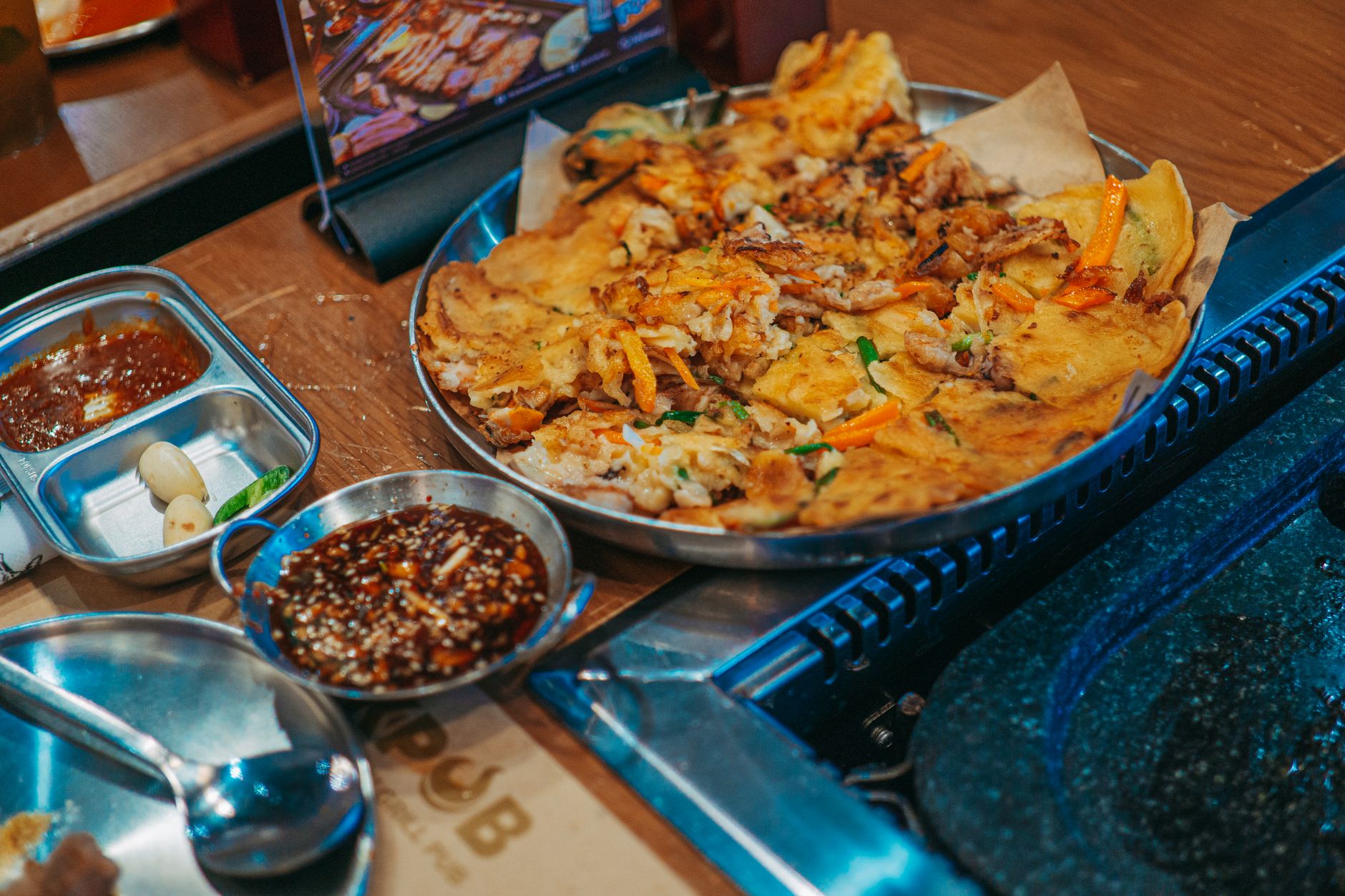
Photo by FOX ^.ᆽ.^= ∫ on Pexels
Where to Drink Makgeolli in Korea
Seoul
Insadong (인사동) is the most accessible neighborhood for first-timers — a tourist-friendly area where makgeolli bars sit alongside craft shops and galleries. Jongno (종로) has older-style pojangmacha and traditional taverns with a more local, less curated atmosphere. Euljiro (을지로) has a younger, craft-focused scene. Mangwon-dong (망원동) and Yeonnam-dong (연남동) are quieter residential neighborhoods where genuine neighborhood makgeolli bars still operate.
Notable venues (as of 2026):
Mr. Ahn's Craft Makgeolli (안씨막걸리) 3 Hoenamu-ro, Yongsan-gu. Hours: 17:00–01:00. Approximately ₩60,000–80,000 per person. The first traditional liquor bar in Korea to receive Michelin Bib Gourmand recognition (2023–2024). The focus is on artisan makgeolli sourced from small producers across the country, presented in a fine-dining format. Reservations are mandatory on weekends and should be booked approximately two weeks in advance via CatchTable. Transit: Noksapyeong Station (Line 6), 10-minute walk.
Damotori H (다모토리 H) Yongsan-gu (main branch); Sinchon branch at 37 Yonsei-ro 7-gil, Seodaemun-gu. Hours (Sinchon): 16:00–02:00. Bottles from ₩5,000; a sampler tray of five regional varieties is available under ₩10,000. Specialty: black bean makgeolli. A small venue (~20 seats); reservations recommended.
Mukjeon (묵전): Gangnam-gu. Multiple flavors including original, chestnut, peanut, creamy, and grapefruit. Pairs well with bossam and kimchi tofu.
The Sool Company (더술컴퍼니): Hyehwa-dong, near Hyehwa Station (Line 4). Offers makgeolli-making classes and tastings — a good option for structured learning before exploring bars independently.
The Sool Gallery (전통주 갤러리): Bukchon area, near Anguk Station (Line 3). Government-run, with free tastings of premium traditional liquors. Verify current hours on Naver Maps before visiting.
Outside Seoul
Jeonju — Samcheon-dong Makgeolli Alley (삼천동 막걸리골목): Approximately 10 minutes by taxi from Jeonju Hanok Village (approximately ₩4,000–5,000 fare). An entire block of approximately 12 bars operating on the same banchan refill system. One kettle per person at ₩5,000 includes 8–15 banchan, continuously refreshed. Jeonju is approximately 1.5–2 hours from Seoul by KTX — a realistic day trip.
Gyeongju: Home of Beopju/Gyeongju Makgeolli. The dual-serve style (cheongju from the clear top layer, then makgeolli from the shaken remainder) is a local tradition worth experiencing if you are visiting the city's Silla dynasty heritage sites.
Convenience Stores
For casual drinking, any convenience store (GS25, CU, 7-Eleven, Emart24) carries 2–4 makgeolli brands in the refrigerated section. A 750ml bottle costs approximately ₩1,600–2,300, making it the most affordable way to try the drink. I paid ₩1,700 for a Jipyeong bottle at a GS25 near Gyeongbokgung — cold, freshly stocked, and directly drinkable from the bottle if you are outdoors near the Han River.
Where to Buy Makgeolli and Prices
Convenience stores (편의점): GS25, CU, 7-Eleven, Emart24. Price range ₩1,700–2,500 per 750ml bottle (as of June 2026; up slightly from ₩1,600–2,300 in mid-2024 due to inflation). Fresh (생) varieties are in the refrigerated section; pasteurized varieties may be on regular shelves.
Supermarkets (대형마트): E-Mart, Homeplus, Lotte Mart. Slightly wider selection than convenience stores, with some regional brands. Price range ₩1,800–2,400 per 750ml (as of June 2026).
Traditional liquor specialty stores: - The Sool Company (더술컴퍼니), Hyehwa-dong - The Sool Gallery (전통주 갤러리), Bukchon — free tastings, government-run - Premium and rare regional brands: ₩3,000–120,000+
Traditional markets (전통시장): Gwangjang Market (광장시장), Tongin Market (통인시장), Noryangjin Market (노량진시장). Local and regional makgeolli often available at competitive prices.
Online: Pasteurized varieties are available via Kurly (마켓컬리) and Coupang, with same-day delivery for some fresh brands in Seoul.
The Health Claim — What Is Actually True
Makgeolli is frequently marketed as a health drink in Korea, and some of those claims have genuine scientific backing — but with important caveats.
What the research supports:
Unpasteurized (생) makgeolli contains live lactic acid bacteria, including Pediococcus acidilactici, P. pentosaceus, and Lactobacillus curvatus — confirmed in peer-reviewed research published in Springer Nature (2015). It also contains B vitamins, vitamin C, amino acids, and shows antioxidant activity in laboratory studies. A 2024 Korea Food Research Institute report supports a connection between unpasteurized makgeolli consumption and intestinal health.
What the research does not support:
Anti-cancer, anti-hypertensive, and anti-diabetic claims are based on preliminary in-vitro research only. These effects have not been clinically established in humans at normal consumption levels.
The caveats that matter for tourists:
Most commercial convenience store brands are pasteurized (살균 표시 on the label). Pasteurization destroys all live cultures — there are no active probiotics in those bottles. Additionally, many commercial brands contain aspartame (아스파탐) as a sweetener, which is directly contrary to the health-drink narrative. The 6–8% alcohol content also counteracts meaningful health benefits at any realistic consumption level.
If the probiotic angle is what interests you, look specifically for the 생(生) label and check that the expiry date is within 10–30 days of the production date. Pasteurized bottles with year-long shelf lives have none of the health properties.
What You Need to Know
- The sediment is the drink. Makgeolli without redistributed sediment tastes thin and slightly alcoholic. Always invert 2–3 times before pouring and swirl your bowl before each sip.
- 생(生) vs 살균 matters. "Saeng" (생, fresh/unpasteurized) means live cultures, refrigeration required, 10–30 day shelf life. "Salgyun" (살균, pasteurized) means shelf-stable, often contains aspartame, no probiotics. The label tells you which one you have.
- Commercial brands often contain artificial sweetener. This is not prominently disclosed — check the ingredient list for 아스파탐 (aspartame) if this matters to you.
- Makgeolli is not equivalent to sake. The comparison is frequently made but is misleading. Sake uses purified yeast and is filtered to near-clarity. Makgeolli uses wild-culture nuruk, is roughly filtered, and retains sediment. The flavor, production logic, and cultural context are substantially different.
- The "rain and pajeon" ritual is real. If you are in Korea on a rainy day and someone suggests getting makgeolli and pajeon, there is a genuine cultural reason for the association. It is worth following the suggestion.
Practical Tips
- Start with Jangsu or a flavored variety if you are unsure. Jangsu Fresh (장수생막걸리) is the most widely available and is approachable for first-timers. Chestnut-flavored (밤막걸리) and strawberry (딸기막걸리) varieties are even milder and sweeter.
- Always invert, never shake. Two to three slow inversions before opening is the correct technique. Vigorous shaking will cause the carbonation to spray when you open the bottle.
- Order "makgeolli hana juseyo" (막걸리 하나 주세요) to order one kettle or one serving at a bar. Follow it with the anju you want — food ordering is expected.
- Reading the label: If the expiry date is 12 months or more from the production date, the bottle is pasteurized. If it is 10–30 days, it is fresh. No Korean required.
- Take pasteurized varieties home. If you want to bring makgeolli back from Korea, pasteurized bottles with year-long shelf life are airport-safe and handle temperature changes well. Fresh varieties have a 10–30 day shelf life and must stay refrigerated — risky for international travel. Standard duty-free alcohol limits apply at your destination country.
- For the best experience outside Seoul, go to Jeonju. The Samcheon-dong Makgeolli Alley (삼천동 막걸리골목) at ₩5,000 per kettle with unlimited banchan refills represents genuinely exceptional value. It is approximately 1.5–2 hours from Seoul by KTX.
- Craft makgeolli classes are available in Seoul. Multiple operators run makgeolli-making experiences in the ₩40,000–80,000 range. GetYourGuide and Klook list current options — useful if you want hands-on context before drinking your way through the city.
Frequently Asked Questions
What does makgeolli taste like?
Makgeolli is sweet, tangy, mildly bitter, and lightly fizzy at the same time — somewhat like a milky, low-alcohol sparkling drink with a noticeable sourness. The texture is thicker than beer and lighter than milk. Commercial brands tend toward the sweeter end; craft and regional varieties are drier and more complex. The flavor shifts depending on the brand, how recently it was bottled, and whether it has been shaken before serving. Dongdongju, the closely related unfiltered variant, tastes slightly sweeter with a more pronounced rice character.
How strong is makgeolli compared to soju or beer?
Most convenience store makgeolli brands are 6% ABV — lighter than wine (12–14%), roughly comparable to standard lager beer, and significantly weaker than soju (16–25%). Craft and artisanal versions range from 9–13%. A few novelty high-ABV products exist in the 14–19% range but are not commonly encountered at standard bars. For most tourists, makgeolli from a convenience store is the most manageable alcoholic drink in the Korean lineup in terms of strength.
What is the difference between makgeolli and dongdongju?
Both are made from fermented rice using the same process and ingredients. The difference is in filtration and dilution. Makgeolli is aggressively filtered through fine cloth — the result is uniformly cloudy white with no visible solids. Dongdongju is minimally strained and harvested earlier, so whole rice grains float visibly in the liquid. Dongdongju is also undiluted, making it stronger (approximately 10%+ ABV) and slightly sweeter. Makgeolli is widely available at convenience stores; dongdongju is mainly found at traditional restaurants and outdoor pojangmacha.
Do I need to shake makgeolli before drinking?
Yes — gently. Invert the bottle two or three times before opening to redistribute the chalky sediment that collects at the bottom. Do not shake hard: the natural carbonation will cause it to overflow when opened. After pouring into a bowl, swirl the bowl before each sip because the sediment resettles quickly. Skipping this step produces a drink that tastes thin and unbalanced.
Is makgeolli actually good for you?
Unpasteurized (생) varieties contain live lactic acid bacteria — confirmed by peer-reviewed research — as well as B vitamins, vitamin C, and amino acids. A 2024 Korea Food Research Institute report supports a connection to intestinal health. That said: most commercial convenience store brands are pasteurized and contain no active probiotics. Many also contain aspartame. And 6–8% alcohol at any meaningful volume offsets most health benefits. The honest answer is that unpasteurized makgeolli has real nutritional content, but it is not a health drink by any practical measure.
Can I bring makgeolli home from Korea?
Pasteurized varieties (살균, with a 12-month shelf life) travel well and are airport-safe. Fresh (생) varieties have a 10–30 day shelf life and require refrigeration — risky for international flights, especially long-haul. Most countries allow 1–2 liters of alcohol duty-free for personal import; check your home country's specific customs rules before buying. Korea does not restrict the export of makgeolli under standard alcohol export rules, but confirm this if you are buying a large quantity.
Related Questions
- Drinking in Korea: Complete Guide for Tourists 2026 — Everything you need to know about Korean drinking culture, etiquette, and the full range of alcoholic drinks available.
- Soju Guide: Types, ABV, Brands, and How to Drink It in Korea (2026) — A detailed breakdown of Korea's most popular spirit, from green bottle Chamisul to premium aged varieties.
- Jeju Island Travel Budget Guide: How Much Does a Trip Cost in 2026? — A full cost breakdown for planning a Jeju trip, including food and drink budgets.